
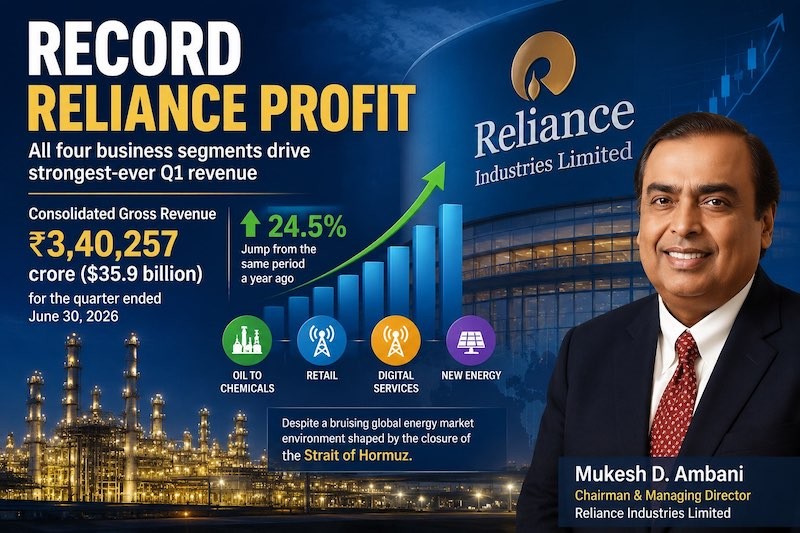
Mumbai/IBNS-CMEDIA: Reliance Industries Limited reported its strongest quarterly revenue on record Thursday, posting consolidated gross revenue of ₹3,40,257 crore ($35.9 billion) for the quarter ended June 30, 2026 — a sharp 24.5 per cent jump from the same period a year ago — as all four of its major business segments delivered growth despite a bruising global energy market environment shaped by the closure of the Strait of Hormuz.
Consolidated EBITDA — earnings before interest, taxes, depreciation and amortisation — hit ₹54,067 crore ($5.7 billion) on a recurring basis, up 10.1 per cent year-on-year and a record for any single quarter. Profit after tax came in at ₹23,196 crore ($2.5 billion), rising 6.1 per cent from a year earlier. Capital expenditure for the quarter stood at ₹38,682 crore ($4.1 billion), with significant deployment into new energy projects and O2C infrastructure.
Conglomerate’s first-quarter earnings beat expectations across all major businesses despite Middle East-driven energy market turmoil; Jio files DRHP with SEBI ahead of landmark public listing
The headline numbers, however, were almost secondary to the quarter’s most consequential announcement: Jio Platforms Limited has filed its Draft Red Herring Prospectus with the Securities and Exchange Board of India, setting the stage for what is expected to be one of the largest initial public offerings in Indian corporate history.
Jio: the crown jewel moves toward listing
Jio Platforms — Reliance’s digital services arm spanning mobile connectivity, broadband, enterprise services and a rapidly expanding content ecosystem — delivered record quarterly EBITDA of ₹20,865 crore, up 15.1 per cent year-on-year, with an industry-leading EBITDA margin of 53.3 per cent. Revenue from operations grew 11.8 per cent to ₹39,173 crore.
The subscriber base crossed 533 million, with 285 million now on Jio’s True5G network — a net addition of 73 million 5G subscribers over the past twelve months. Average revenue per user (ARPU) climbed to ₹215.6 per month, up from ₹208.8 a year ago. Data traffic surged 26.9 per cent year-on-year to 69 exabytes for the quarter, with each user consuming an average of 43.7 gigabytes per month.
In a striking global recognition, Jio Platforms climbed 320 places in the World Intellectual Property Organisation’s Patent Cooperation Treaty rankings for 2025, breaking into the global top 20 among innovators worldwide — a list otherwise dominated by US and Chinese technology giants. Jio’s patent portfolio spans 5G, 6G, artificial intelligence, cloud-native platforms, edge intelligence and network slicing.
“Jio has established itself as a deep tech company,” said Akash M. Ambani, Managing Director of Jio Platforms. “As we embark on our next phase of journey to be a publicly listed company in India, we will continue to maintain our deep tech focus and democratise access to digital connectivity and digital services in India and globally.”
The Jio IPO, once it clears regulatory review, is expected to unlock significant value for Reliance shareholders and give retail and institutional investors direct exposure to India’s fastest-growing digital infrastructure play.
JioStar: IPL propels platform to record highs
JioStar — the merged entertainment and streaming entity — reported gross revenue of ₹12,799 crore for the quarter, up 14.1 per cent year-on-year, driven by IPL 2026, which became the most-watched T20 event in history with a combined reach of 1.2 billion viewers across digital and linear television.
JioHotstar averaged 530 million monthly active users during the quarter, its highest ever, while IPL’s digital reach alone touched 700 million. EBITDA from operations surged 30.7 per cent year-on-year to ₹933 crore.
New product launches added momentum. Tadka, a microcontent hub, crossed 100 million active users within two months of launch, with daily watch time per viewer growing fivefold since its debut. A conversational discovery feature built in partnership with ChatGPT has shown consistent growth in user engagement month-on-month. JioStar also launched an AI-generated micro-drama — the first of its kind — powered by its in-house JAMS platform.
On linear television, JioStar maintained a 34 per cent viewership share nationally, with dominance in Hindi-speaking markets at 44 per cent. The network’s kids’ vertical holds a 47 per cent viewership share, making it the country’s top-ranked children’s television network.
O2C: Hormuz crisis becomes a tailwind
In what might appear counterintuitive, the closure of the Strait of Hormuz — the world’s most critical oil chokepoint, through which approximately 13 million barrels per day typically flow — became a significant earnings catalyst for Reliance’s Oil to Chemicals segment.
O2C revenue surged 30.4 per cent year-on-year to a record ₹2,01,803 crore ($21.3 billion), while EBITDA rose 17.2 per cent to ₹17,010 crore ($1.8 billion). The key driver was a dramatic spike in transportation fuel cracks: Singapore gasoil margins rose 299 per cent year-on-year to $63 per barrel, while jet fuel margins surged 343 per cent to $62.9 per barrel. Dated Brent crude averaged $104.5 per barrel during the quarter, up $36.7 per barrel from the same period a year ago.
Reliance navigated the supply disruption through crude basket diversification — sourcing more heavily from Russia and Latin America — while absorbing headwinds from higher freight and insurance costs and the reintroduction of the Special Additional Excise Duty on diesel, petrol and aviation turbine fuel.
The conglomerate took a significant domestic policy step during the crisis, diverting propane and butane to boost LPG output and holding retail fuel prices steady — a decision that compressed fuel retailing margins but protected Indian consumers from the worst of the global price shock.
Jio-bp, Reliance’s fuel retail joint venture with BP, now operates 2,221 outlets nationally and reported motor spirit volume growth of 16.8 per cent year-on-year. Its EV charging network crossed 5,820 live charging points, with monthly footfall at Jio-bp Pulse crossing 50,000 customers.
Reliance Retail: digital commerce leads the next growth phase
Reliance Retail Ventures reported gross revenue of ₹90,408 crore, up 7.4 per cent year-on-year — or 11.6 per cent adjusted for the demerger of the consumer brands business (RCPL) into a separate entity. The registered customer base reached 396 million, up 10.6 per cent, with 568 million transactions recorded in the quarter — a remarkable 46 per cent jump year-on-year that reflects the accelerating conversion of its vast physical store network into an omnichannel commerce engine.
EBITDA, however, dipped marginally to ₹6,309 crore, down 1.1 per cent, as the company absorbed the fixed cost of scaling its digital commerce infrastructure. The management framed this explicitly as investment-driven compression rather than structural weakness.
Grocery digital commerce stood out, with average daily orders growing 116 per cent year-on-year. Ajio Rush, the fast-delivery fashion vertical, recorded 136 per cent quarter-on-quarter order growth, while Shein — operating through Reliance’s platform in India — crossed 30 million app installs. JioMart now services approximately 5,500 pin codes with two-hour delivery.
“Our continued investment in digital commerce underscores the transformative power of our digital platforms,” said Isha M. Ambani, Executive Director of Reliance Retail. “Our expanding customer base, widest store network, and growing omni-channel capabilities position us well to continue fulfilling every need, every dream, for every Indian, every day.”
Moody’s upgrades; debt picture improves
In a vote of confidence from global capital markets, Moody’s Ratings upgraded Reliance’s foreign currency debt issuances to ‘Baa1’ during the quarter, citing the underlying strength of the conglomerate’s cash flows and financial position. Net debt fell to ₹1,22,914 crore from ₹1,24,717 crore in the previous quarter, with a net debt to EBITDA ratio of 0.57 — among the lowest in the company’s recent history and well within investment-grade comfort zones.
Chairman’s word
“Reliance has made a steady start to FY27, with all businesses delivering strong operating performance,” said Mukesh D. Ambani, Chairman and Managing Director. “The start to FY27 gives me reason to be optimistic about the year ahead as we move forward with phased commissioning of new energy projects and unlock value through the Jio IPO.”
The big picture
Thursday’s results confirm what has been building for several quarters: Reliance is successfully executing a structural transition from an energy and petrochemicals conglomerate toward a diversified technology and consumer enterprise. Digital services now contribute the largest single segment EBITDA at ₹21,255 crore, edging past O2C’s ₹17,010 crore for the first time on a comparable basis — a milestone that would have been unimaginable a decade ago.
The Jio IPO, when it arrives, will be the punctuation mark on that transition. Whether it becomes the landmark event that Ambani and his team are positioning it as depends on market conditions, SEBI timelines and investor appetite for a company that is, at its core, a bet on India’s digital future.
That bet, on the evidence of these numbers, is looking increasingly well-placed.