
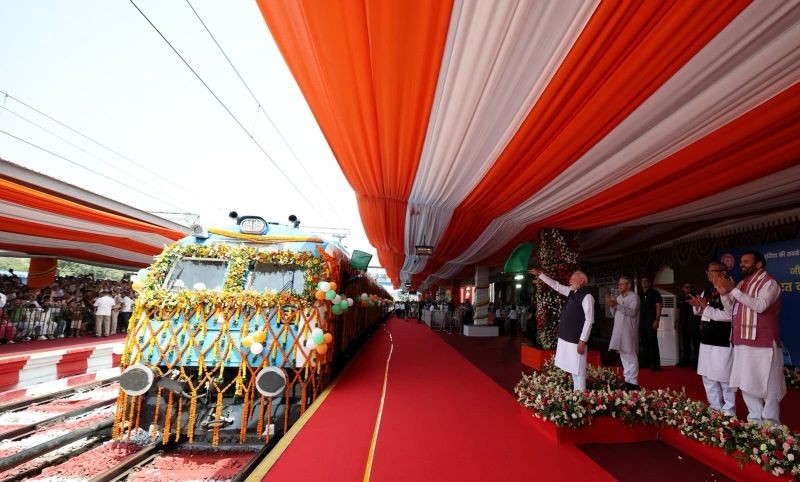
IBNS-CMEDIA: India on Friday joined a select group of nations, including the United States, after unveiling the country’s first indigenous hydrogen-powered train, marking a major step towards zero-emission rail transport and clean-fuel technology.
Prime Minister Narendra Modi flagged off the hydrogen-powered train on the Jind–Sonipat section of the Northern Railway.
Announcing the launch on X, Modi wrote: “India takes a major leap towards green mobility!”
India takes a major leap towards green mobility!
In Jind, flagged off India’s first indigenous hydrogen-powered train between Jind and Sonipat.
This remarkable achievement reflects the ingenuity and dedication of the Indian Railways team. It is a proud symbol of Aatmanirbhar… pic.twitter.com/hVo89u5vvI
— Narendra Modi (@narendramodi) July 17, 2026
He added: “In Jind, flagged off India’s first indigenous hydrogen-powered train between Jind and Sonipat. This remarkable achievement reflects the ingenuity and dedication of the Indian Railways team. It is a proud symbol of Aatmanirbhar Bharat and our commitment to cleaner, future-ready transportation.”
Earlier, the government said the pilot project combines advanced hydrogen fuel cell propulsion technology with dedicated hydrogen storage, refuelling and operational infrastructure, demonstrating the feasibility of clean rail transportation in India.
Developed entirely in India in accordance with design approvals and technical specifications prepared by the Research Designs and Standards Organisation (RDSO), the project reflects Indian Railways’ commitment to innovation, energy efficiency and environmentally sustainable transportation while advancing the vision of Aatmanirbhar Bharat.
Which countries operate hydrogen-powered trains?
India now joins a small group of countries that have introduced hydrogen-powered passenger trains or are operating them on pilot or commercial routes. These include:
Germany – The world’s first commercial hydrogen-powered passenger trains entered service in 2022.
United States – Hydrogen-powered passenger train projects are under development and demonstration.
China – Hydrogen-powered urban rail and tram systems have undergone successful trials.
France – Hydrogen regional trains are being tested for commercial deployment.
Italy – Hydrogen train projects are under implementation for regional routes.
Austria – Hydrogen-powered trains have undergone demonstration runs.
United Kingdom – Prototype hydrogen trains have been successfully tested.
Canada – Hydrogen passenger train demonstration projects are underway.
Key features of India’s hydrogen-powered train
The 10-coach hydrogen fuel cell-based trainset has been designed and manufactured in India and features:
A 1,200 kW hydrogen fuel cell propulsion system.
Maximum operational speed of 75 kmph, with a design speed of 110 kmph.
Passenger capacity of around 2,600.
Development from the design stage through prototype manufacturing entirely within India.
Two Hydrogen Driving Power Cars (DPCs) and eight Trailer Coaches (TCs).
The train will operate between Jind Junction and Sonipat, passing through Gohana Junction and several intermediate stations, including Jind City, Pandu Pindara Junction, Lalit Khera Halt, Bhambhewa, Isapur Kheri Halt, Butana Halt, Khandrai Halt, Rabrah Halt, Lath Halt, Mohana, Barwasni Halt and Sonipat New.
Hydrogen infrastructure
To support operations, Indian Railways has established the country’s largest railway hydrogen storage and refuelling facility at Jind, Haryana.
The indigenous facility can store nearly 3,000 kg of hydrogen and has received the required licence from the Petroleum and Explosives Safety Organisation (PESO) for the storage and dispensing of compressed hydrogen gas.
The hydrogen ecosystem has been designed in line with internationally accepted safety standards, including NFPA-2 (National Fire Protection Association) and the ISO 19880 Series. The entire system has undergone an independent third-party safety assessment by TÜV SÜD, Germany, one of the world’s leading technical inspection and certification agencies.
Each Hydrogen Driving Power Car houses hydrogen fuel cells, lithium iron phosphate (LFP) batteries and hydrogen storage cylinders.
The supporting infrastructure includes:
A hydrogen compression system for refuelling.
Technical support facilities and critical spare parts.
A standby compressor to ensure uninterrupted refuelling operations.
Comprehensive safety framework
Indian Railways has put in place a multi-layered operational and safety framework for hydrogen train operations.
Operational preparedness
Standard operating procedures and regular safety audits have been established.
The maintenance facility at Shakurbasti, Delhi, has been upgraded for hydrogen train operations.
Trained and certified personnel will oversee critical operations.
Technical experts will accompany the train during its initial phase.
The hydrogen refuelling system will be monitored round the clock.
Safety measures
The train and associated infrastructure incorporate multiple safety systems, including:
Hydrogen leak detectors at production, storage and dispensing facilities.
Continuous flame detection systems.
Regular inspection and maintenance of safety sensors.
Continuous ventilation throughout the train.
Automatic shutdown of hydrogen supply if heat, flame or smoke is detected.
An emergency operating mode that enables the loco pilot to move the train to a safe location if required.
A real-time system health monitoring display in the driver’s cabin.
Scheduled inspections and preventive maintenance to ensure safe and reliable operations.
The project is expected to serve as a technological demonstration for the future adoption of hydrogen-powered rail transport in India while supporting the country’s broader clean energy and decarbonisation goals