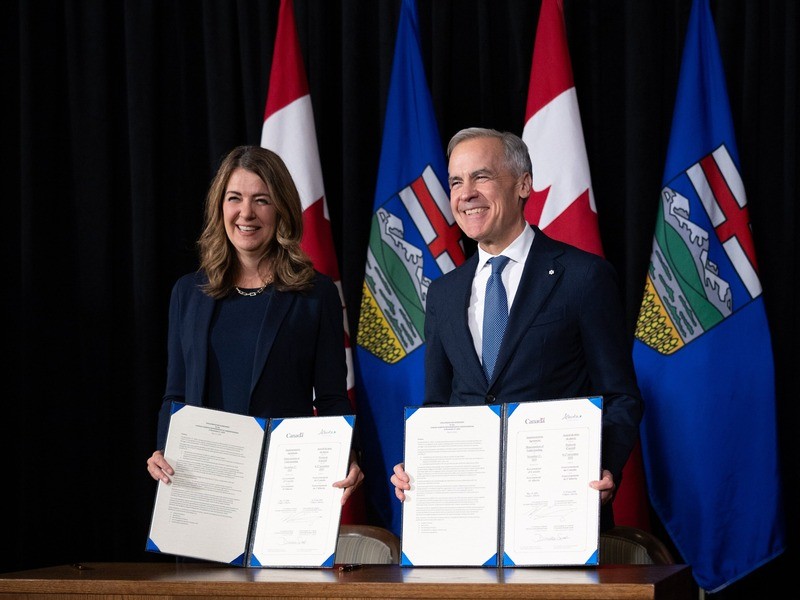
Ottawa/IBNS-CMEDIA: Canada’s federal government and the province of Alberta on Friday reached an energy and climate agreement that includes higher industrial carbon pricing, plans to expand electricity generation and support for a proposed oil pipeline to Asian markets.
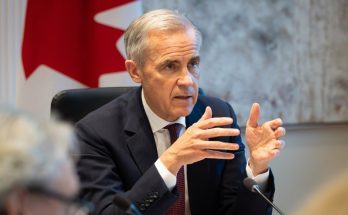
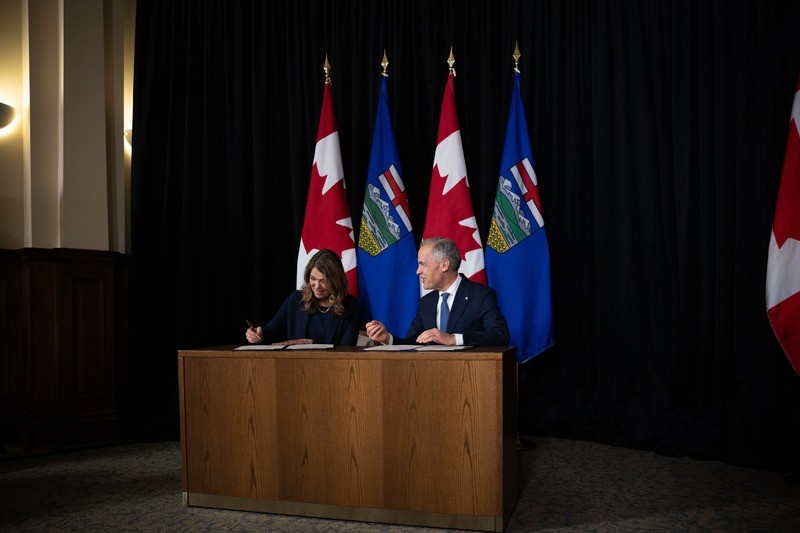
Prime Minister Mark Carney and Alberta Premier Danielle Smith stated the implementation agreement builds on a memorandum signed last year intended to align federal and provincial energy and climate policies.
Under the deal, Canada and Alberta agreed to establish an industrial carbon price of C$130 ($94.50) per tonne by 2040, with interim benchmarks of C$115 by 2030 and C$130 by 2035. The headline carbon price would rise to C$140 per tonne by 2040.
The agreement also includes a minimum price floor for Alberta’s Technology Innovation and Emissions Reduction (TIER) carbon credits beginning in 2030, as well as the joint issuance of 75 million tonnes of Carbon Contracts for Difference to support emissions-reduction projects.
According to a statement, the measures are intended to provide greater certainty for investors and support Canada’s goal of reaching net-zero emissions by 2050.
The federal and provincial governments also agreed to work toward doubling Alberta’s electricity grid capacity by 2050 through investments in nuclear, wind, solar, geothermal and lower-carbon energy generation.
A joint electricity working group will be established to identify infrastructure and technology needs, including transmission, storage and grid modernisation projects.
The agreement further advances plans for a proposed pipeline that would transport at least one million barrels per day of Alberta bitumen to Asian markets.
Under the plan, Alberta will submit a formal proposal for the pipeline to Canada’s Major Projects Office by July 1, while the federal government will consider designating it a project of national interest under the Building Canada Act by October 1.
The project would depend on the proposed Pathways carbon capture and storage initiative, which the governments said could reduce emissions by 16 million tonnes annually while supporting economic growth and jobs.
Carney said the agreement would create “a more prosperous, sustainable, and resilient economy”, while Smith said it signalled to investors that Alberta and Canada were committed to expanding market access and accelerating major infrastructure development.
The agreement follows earlier federal-provincial deals aimed at streamlining environmental reviews and infrastructure approvals under a “one project, one review” framework.
(Reporting by Suman Das)