
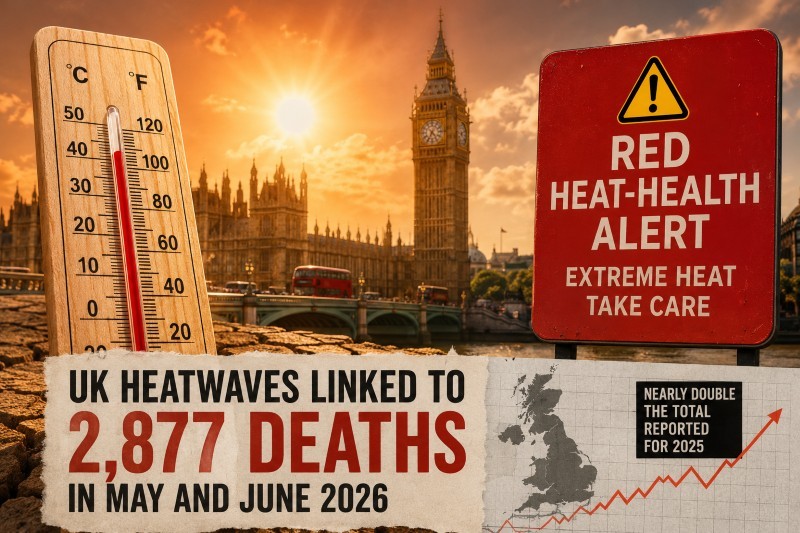
IBNS-CMEDIA: Rapid early assessment by the UK Health Security Agency (UKHSA) estimates that 2,877 heat-associated deaths occurred in the UK during two major periods of hot weather in May and June 2026, nearly double the total reported for the whole of 2025.
According to the assessment, an estimated 753 deaths were associated with the heat episode between May 24 and 27, while a further 2,124 deaths were linked to the June 21–28 heatwave.
Although the figures remain provisional, they are already approaching the annual record reported by UKHSA in 2022.
The June heatwave lasted for eight days and prompted the issuance of a Red Heat-Health Alert—only the second time the highest level of alert has been declared in England—highlighting the exceptional temperatures recorded, UKHSA said in a statement.
Both May and June also set new Met Office monthly temperature records for England. A temperature of 31.5°C was recorded at Kew Gardens on May 26, while 37.7°C was recorded at Lingwood, Norfolk, on June 26.
UKHSA said the findings underscore the importance of the Heat-Health Alert system, developed in partnership with the Met Office, which provides early warnings when high temperatures are expected to significantly affect public health and wellbeing.
The agency noted that heatwaves occurring earlier in the season can have a greater health impact because people, communities and essential services have had less time to adapt to rising temperatures.
To strengthen preparedness, UKHSA recently published the updated Adverse Weather and Health Plan for England 2026–2027, aimed at helping partners respond more effectively to extreme weather events.
Based on the interim assessment, UKHSA said 2026 is likely to record the highest number of heat-associated deaths on record, surpassing the 2,985 deaths reported in 2022, if further periods of extreme heat occur during the remainder of the summer.
Dr. Ross Thompson, Principal Environmental Public Health Scientist at UKHSA and author of the report, said: “These figures highlight the significant danger that very hot weather can pose to people’s health. This is particularly true for those who are more vulnerable, including older adults and people with underlying medical conditions.”
“While the figures are interim, they suggest that, if we experience more periods of hot weather this summer, we could see the highest number of heat-associated deaths on record,” Thompson said.
“As the climate becomes warmer, we can expect periods of hot weather to become longer, more frequent and more extreme. That’s why it’s vital that individuals, communities and systems are prepared to deal with higher temperatures, and to ensure those most vulnerable to the heat are protected,” he added.
Health and Social Care Secretary Yvette Cooper said: “The sweltering heat has had a serious impact this summer on people’s health and on our NHS.”
“For many years, we have been used to winter pressures in our NHS and the need to support those who are vulnerable in the coldest weather. But now we are seeing the summer heat have an increasingly serious impact on the health of thousands of people, and on the pressures facing our NHS too,” Cooper said.
“My thoughts are with all those who have lost loved ones as a result of the long and intense heatwaves in recent months. And my heartfelt thanks go to the NHS staff, care workers and emergency responders who have worked tirelessly through these exceptionally busy and challenging months to protect and care for people affected by the heat,” she added.