By Sujoy Dhar
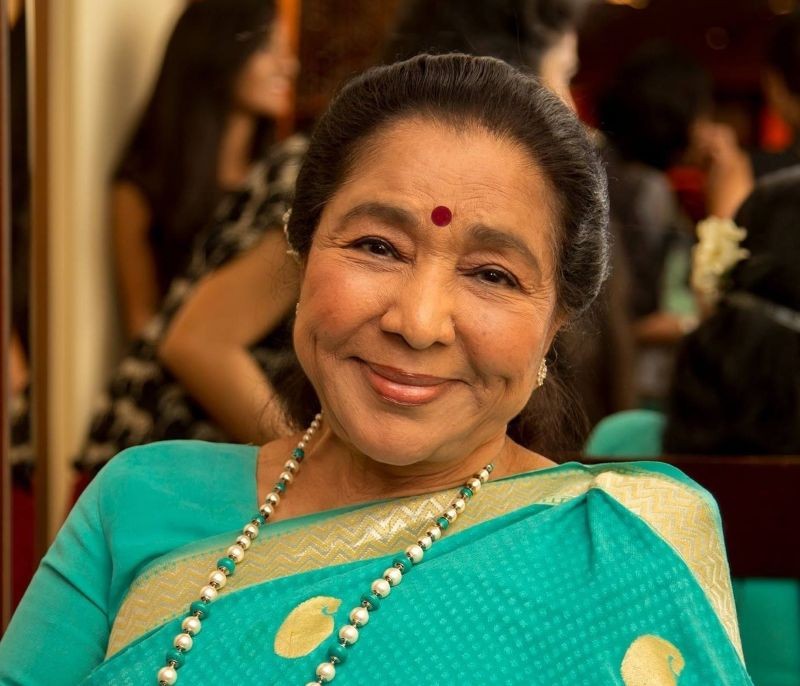
IBNS-CMEDIA: Winner of the Dadasaheb Phalke Award (2000), the Padma Vibhushan (2008), and seven Filmfare Awards. 12,500 songs. One voice. From cabaret to ghazal, from heartbreak to disco, she sang everything India felt but could not articulate. There will never be another. An IBNS tribute to Asha Bhosle (1933-2026) — singer, actor, restaurateur, grandmother, and the most recorded artist in human history.
It is 1971. A dimly lit cabaret set on a Bollywood soundstage. Helen, in sequins, begins to move. And then the voice arrives — bold, brazen, dripping with something between mischief and desire — “Piya tu ab to aaja, aa bhi jaa, aa bhi jaa…”
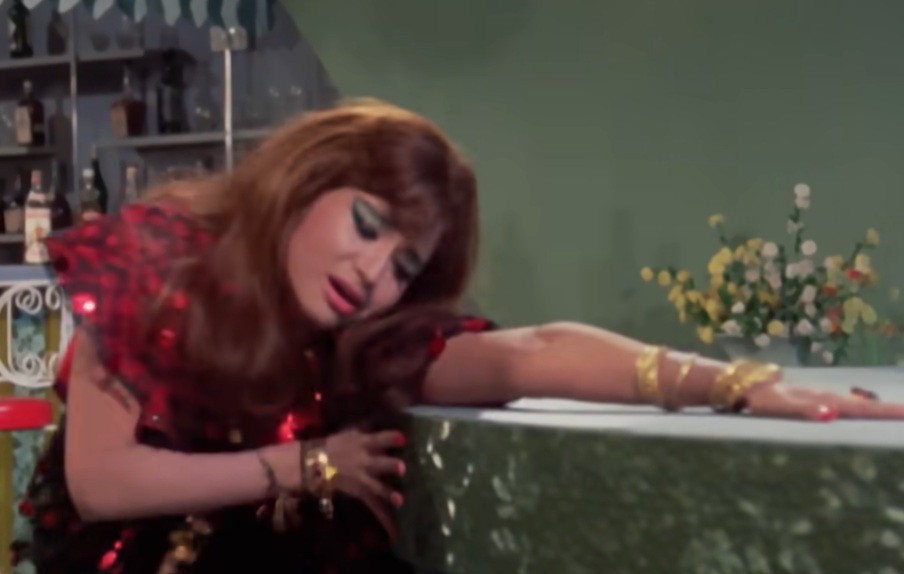 Asha lent her voice to the mesmerizing ‘Piya tu ab to aaja’ starring Helen. Photo: Screengrab from YouTube video.
That voice did not belong to the scene. It transcended it. It was not merely singing a cabaret number — it was reinventing what a woman’s voice was permitted to do in Indian cinema. Sensuous without apology. Playful without shame. Alive in a way that made everything around it seem, briefly, more vivid.
That was Asha Bhosle. That was always Asha Bhosle.
The other Mangeshkar — and why that framing was always wrong
She was born Asha Mangeshkar on September 8, 1933, in Sangli, Maharashtra, into a family where music was not an aspiration but a bloodline. Her father, Pandit Deenanath Mangeshkar, was a revered classical singer and stage actor.
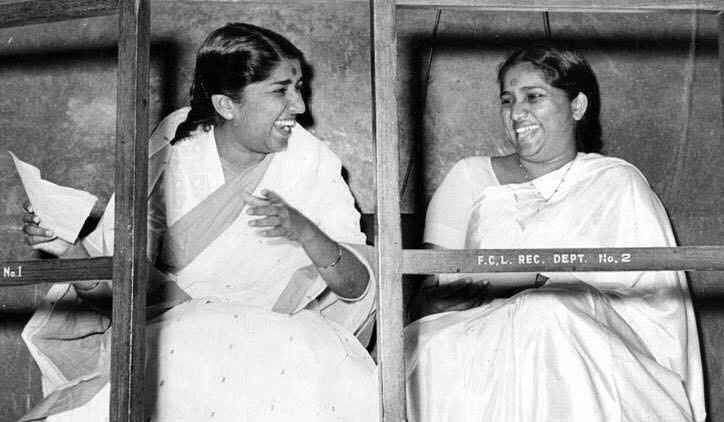 Asha Bhosle with her sister and legendary singer Lata Mangeshkar. Photo: Official Facebook.
When he died young, leaving behind five children and little else, the family moved to Mumbai and the eldest daughters — Lata and Asha — began singing to survive.
For decades, the world would insist on seeing Asha through the shadow of her elder sister. It was a framing she quietly, stubbornly refused. Where Lata was the voice of purity, devotion and classical restraint — the goddess on the plinth — Asha was the woman in the street, in the rain, in the nightclub, in the bedroom. She was earthier, bolder, more dangerous. She went where Lata would not, or could not, go.
And there were years — whole glorious years — when Asha was simply more popular. When the foot-tapping, hip-swinging, whisky-soaked songs of the 1960s and 70s demanded a voice that could carry both ache and abandon, it was Asha they called. O.P. Nayyar, the irrepressible composer who swore he would never record with Lata, built an entire sonic universe with Asha instead — Aao Huzoor Tumko, Ude Jab Jab Zulfen Teri, song after glittering song. It was a partnership of extraordinary creative electricity.
But it was with Rahul Dev Burman — Pancham Da — that Asha found not just her greatest musical collaborator, but eventually, her great love.
Pancham and Asha: the love story India danced to
Their first major collaboration came with Teesri Manzil in 1966. Aaja Aaja Main Hoon Pyar Tera — a song so Westernised, so rock-and-roll in its swagger, that Asha herself initially doubted she could sing it. She took it as a challenge instead. Ten days of rehearsals. And then magic. Shammi Kapoor, the film’s star, would later say that if he had not had Mohammad Rafi to sing for him, he would have wanted Asha Bhosle.
What followed over the next two decades was arguably the most fertile creative partnership in the history of Hindi film music. Dum Maro Dum. Chura Liya Hai Tumne Jo Dil Ko. Yeh Mera Dil. Piya Tu Ab To Aaja. Hungama Ho Gaya. Jawani Jan-e-Man. RD Burman composed for Asha’s voice the way a master sculptor works with the one material that understands his hands. She, in turn, gave his arrangements a humanity and heat that no one else could.
Privately, their story was complicated and tender. Both had been through difficult first marriages. Asha had married Ganpatrao Bhosle at sixteen — against her family’s wishes, in what she later described as an act of rebellion that cost her dearly. The marriage was marked by control and cruelty. She left with her children and very little else, rebuilding herself one song at a time.
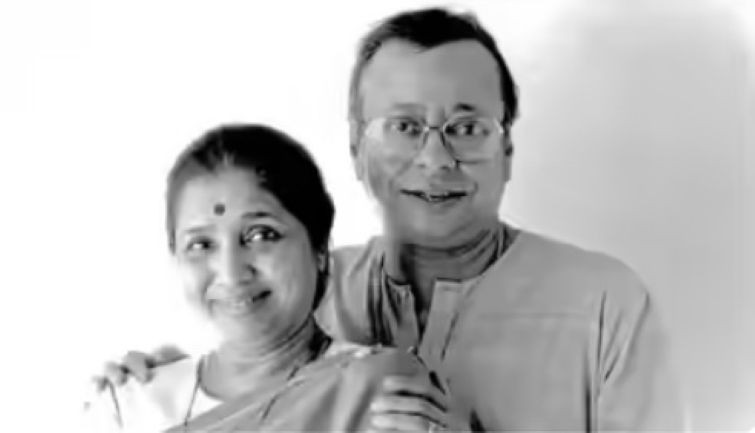 Asha Bhosle married iconic music composer RD Burman in 1980. Photo: Viral X image.
RD Burman had admired her for years before they finally came together. She was initially hesitant. He was persistent, patient, certain. They married in 1980, quietly. For the years they had together before his death in 1994, they were each other’s greatest companions. She never quite recovered from losing him. She did not need to say so. It was audible in the silence she sometimes carried on stage.
The range that made her immortal
To list what Asha Bhosle could sing is to list nearly every mood the human heart is capable of.
She sang the ghazals of Umrao Jaan — Dil Cheez Kya Hai, In Aankhon Ki Masti — with a classical restraint and melancholy so precise it seemed to come from another century. She sang the disco abandon of the 1980s with Bappi Lahiri.
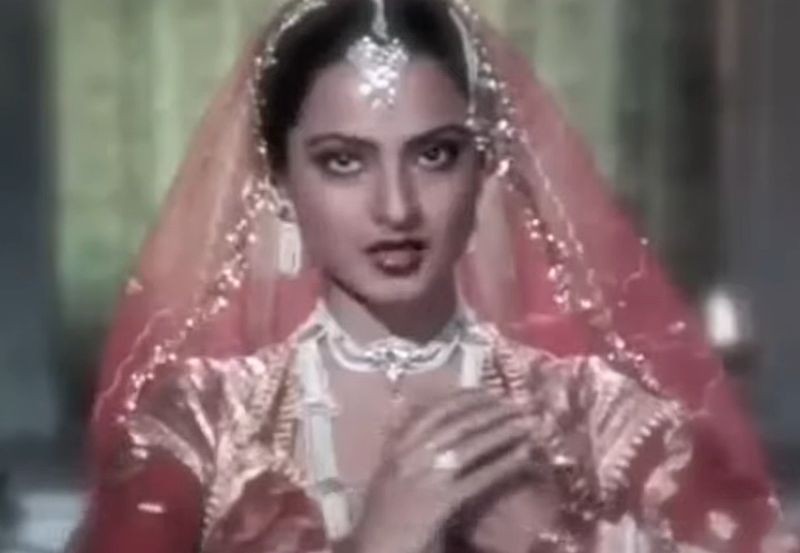 A still from Asha Bhosle’s iconic song ‘Dil Cheez Kya Hai’ featuring actress Rekha. Photo: Screengrab from YouTube video.
She sang A.R. Rahman’s layered compositions in Rangeela — Tanha Tanha, Rangeela Re — and made them her own at an age when most singers had long since faded. She recorded with Boy George.
She collaborated with the Kronos Quartet and received a Grammy nomination. In 2026, at 92, she appeared on a Gorillaz album. She did not know how to stop.
The Guinness World Records named her the most recorded artist in music history — over 12,500 songs across more than 20 languages, a figure that staggers the imagination. But statistics never captured what made her extraordinary.
What made her extraordinary was that across eight decades, across every genre, every era, every composer she worked with, every leading lady she gave voice to — from Madhubala and Meena Kumari to Zeenat Aman, Urmila Matondkar and Kajol — she remained unmistakably, irreducibly herself.
 She sang for AR Rahman’s ‘Tanha Tanha’ from Rangeela, featuring Urmila Matondkar. Photo: Screengrab from YouTube video.
You always knew it was Asha. There was a signature in her breath, a particular quality of presence in her lower register, a way she inhabited a lyric that no other singer replicated. She did not simply perform a song. She lived briefly inside it, and then handed it back to you, transformed.
A life that took everything and gave it back as music
Her personal life asked a great deal of her. The early marriage and its cruelties. The years of struggling as a single mother while her sister’s career soared and hers was dismissed as the lesser path. The grief of losing RD Burman. The death of her son Hemant in 2015.
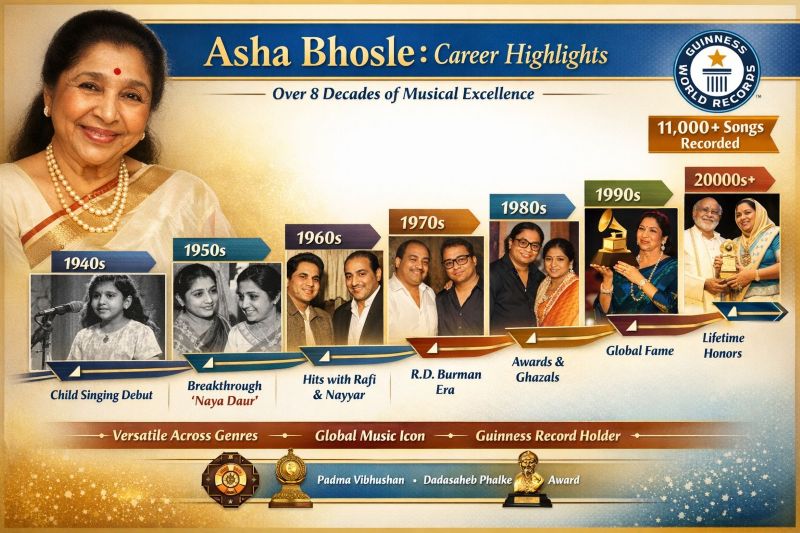
The devastating loss of her daughter Varsha in 2012 — a private tragedy she bore with characteristic dignity, saying little and bearing much.
She outlived her elder sister Lata Mangeshkar, who died in 2022, leaving Asha as the last of that extraordinary generation — the last living link to the golden age of Hindi cinema, to a time when a song recorded in a single studio session could make an entire nation feel something simultaneously.
She cooked elaborate meals for friends and spoke about food with the same passion she brought to music. She launched restaurants. She judged reality shows. She performed at ASHA@90: Live in Concert in Dubai in 2023, and the audience stood and wept.
She was, to borrow the word she embodied, indefatigable.
What India loses
There is a particular kind of grief that comes with the loss of a voice — not a face or a name, but a voice. Because a voice lives inside you differently. It arrives through the ear and settles somewhere deeper, in the part of you that formed before memory, in the place where emotion and music become the same thing.
Generations of Indians grew up with Asha Bhosle’s voice as a kind of ambient inheritance — present at weddings and in rain-soaked evenings, on transistor radios and on phones, in films watched on Sunday afternoons and in the quiet of late nights. She was the sound of celebration and the sound of longing. She was the cabaret and the ghazal and the lullaby and the disco floor.
She was what India sounded like when it was most alive.
To lose Asha Bhosle is to lose something that cannot be replaced or digitally reconstructed or adequately mourned in words. It is to lose the last great voice of a world that no longer exists except in the songs she left behind.
Those songs, at least, do not go.
Piya tu ab to aaja. Come now, beloved.
She came, every time. For eighty years, she came.
(Note: One of the images used in the story is ChatGPT recreated)