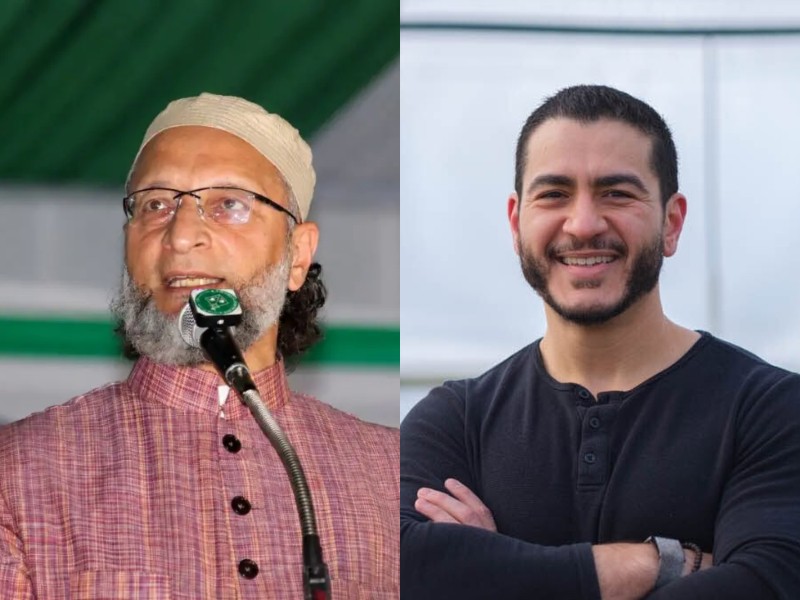
IBNS-CMEDIA: A Muslim candidate’s historic victory in the United States Senate has given AIMIM chief Asaduddin Owaisi fresh ammunition to push his campaign for independent Muslim political leadership in Uttar Pradesh, where Assembly elections are due in 2027.
Celebrating Democrat Abdul El-Sayed’s victory in Michigan, Owaisi said it was time for Muslims in Uttar Pradesh to move beyond supporting established political leaders and claim a greater share of political power themselves.
Using his familiar ‘Abdul’ metaphor, the All India Majlis-e-Ittehadul Muslimeen (AIMIM) chief renewed his criticism of the Samajwadi Party (SP) and the Congress, accusing them of treating Muslims as a vote bank without creating enough opportunities for members of the community to emerge as political leaders.
Owaisi’s ‘Abdul’ message after US victory
On Wednesday, November 4, Owaisi took to X to celebrate El-Sayed’s victory and draw a parallel with the political aspirations of Muslims in Uttar Pradesh.
“One Abdul has won in Michigan. Now, Abdul in Uttar Pradesh must strengthen his political identity. The Sanghis have tried very hard to turn ‘Abdul’ into a taunt. The time has come to show that Abdul is subservient to none but Allah. We will no longer lay carpets,” Owaisi posted.
The remark was aimed at what Owaisi described as attempts by the Sangh Parivar to turn the name ‘Abdul’ into a derogatory reference to Muslim men.
He has increasingly used the expression as a symbol of political assertion, arguing that Muslims should no longer remain confined to supporting other parties and their leadership.
His latest statement also renewed his attacks on the SP and the Congress, which he has repeatedly accused of relying on Muslim votes while denying the community adequate political representation and leadership opportunities.
Attack on SP and Congress intensifies
Owaisi has made the ‘Abdul’ metaphor a recurring feature of his campaign rhetoric ahead of the 2027 Uttar Pradesh Assembly elections.
During a rally in Tanda, in Rampur district, on October 18, he called on Muslims to develop their own political leadership.
“Abdul will become a leader, an MLA, an MP,” he said, according to media reports.
“We will no longer make any Nehru, Gandhi, or any Yadav our leader. Young men and women standing in our ranks will become leaders,” Owaisi added.
A week later, on October 25, he sharpened his criticism of SP president Akhilesh Yadav at a rally in Kairana.
“Akhilesh Yadav, the name of your party should be changed from Samajwadi to Samajwadi Yadav Parivar,” he said, targeting what he portrayed as the concentration of political leadership within the Yadav family.
Owaisi’s remarks reflect his attempt to challenge the SP and Congress over their relationship with Muslim voters and make independent political representation a central issue in his campaign.
Who is Abdul El-Sayed?
Abdul El-Sayed, 42, defeated Republican candidate Mike Rogers in Michigan’s November 3 Senate election.
Rogers had received the backing of US President Donald Trump.
The son of Egyptian immigrants and a former public health official, El-Sayed became the first Muslim elected to the US Senate.
His victory also enabled the Democrats to retain the Michigan seat following the retirement of Senator Gary Peters, who had represented the state since 2015, Reuters reported.
El-Sayed’s election came amid significant Democratic gains in the midterm polls, which dealt a setback to Trump’s Republican Party.
His campaign had attracted considerable attention because of his Muslim identity, support for the Palestinian cause and opposition to US military aid to Israel.
These positions became contentious issues, with Republican opponents questioning his political and religious affiliations.
Michigan had voted for Trump in the 2024 presidential election.
El-Sayed’s victory therefore carried particular significance for Democrats seeking to retain political ground in the state.
Trump’s attacks and campaign controversy
El-Sayed’s path to the Senate election was marked by a series of political attacks over his religious identity and views on Israel.
After defeating the Democratic establishment’s preferred candidate, Haley Stevens, in the August primary, he faced intensified opposition from Republicans.
According to the Associated Press, the pro-Israel lobby AIPAC spent nearly $30 million opposing him during the primary, largely because of his criticism of Israel.
Trump personally targeted El-Sayed at a Michigan rally on October 25, calling him a “jihadist” and claiming he was “on the side of the terrorists”.
The US President also said El-Sayed would “have to go through a metal detector before he’s allowed to go into the Senate”.
Republican rival Rogers accused El-Sayed of having links to the Muslim Brotherhood but did not provide evidence for the allegation. El-Sayed denied the claims.
Responding to Trump at a rally in Grand Rapids on the same day, El-Sayed dismissed the attacks and expressed confidence about his electoral prospects.
“I don’t even care that he remembers my whole name because he can just go on and call me ‘senator’ after November,” he said. “I will be Senator Muhammad to you, bro.”
El-Sayed subsequently won the election, retaining the Michigan Senate seat for the Democrats despite the state having backed Trump in the previous presidential election.
Owaisi’s electoral challenge in UP
El-Sayed’s victory has provided Owaisi with a fresh political reference point as he seeks to expand AIMIM’s presence in Uttar Pradesh.
However, translating the ‘Abdul’ slogan into electoral gains remains a challenge for the party.
AIMIM won no seats in the 2022 Uttar Pradesh Assembly elections.
The party subsequently made unsuccessful attempts to negotiate an alliance with the SP and the Congress ahead of the 2027 polls.
With those efforts yielding no results, Owaisi has increasingly focused on challenging the two parties’ influence among Muslim voters and advocating independent political leadership for the community.
His latest remarks following El-Sayed’s Michigan victory have also widened his criticism to the Rashtriya Swayamsevak Sangh (RSS), which he accused of turning the name ‘Abdul’ into a taunt.
According to political experts, by invoking the American election result, Owaisi has sought to link a milestone in Muslim political representation in the United States to his campaign to assert a similar political identity in Uttar Pradesh.