
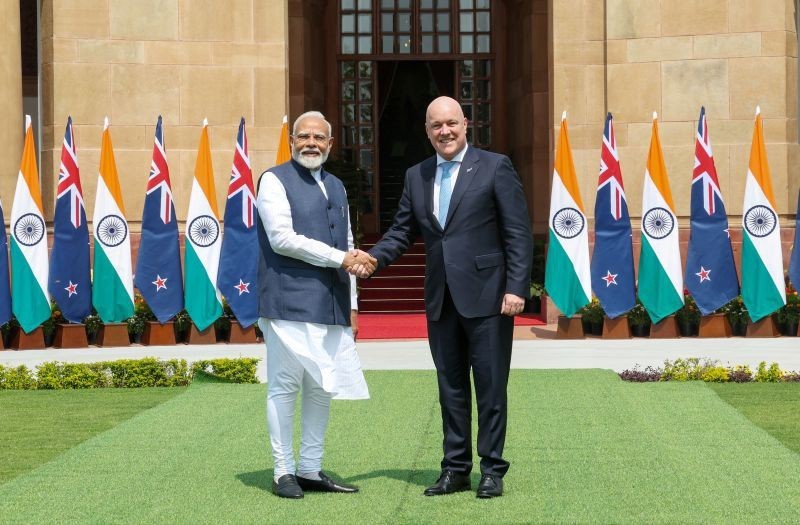
IBNS-CMEDIA: New Zealand Parliament on Wednesday passed legislation to implement its Free Trade Agreement (FTA) with India, marking a major step towards bringing the landmark pact into force.
The legislation was approved by a 93-29 vote, with support from the opposition Labour Party. Under the agreement, tariffs on about 95 per cent of New Zealand’s exports to India will eventually be eliminated or significantly reduced, Moneycontrol reported.
Welcoming the passage of the legislation, New Zealand Trade Minister Todd McClay said the 93-29 vote demonstrated strong parliamentary support for the FTA and the benefits it could bring to the country’s economy.
“The India FTA opens the door for Kiwi exporters to one of the world’s largest and fastest-growing economies. Parliament today overwhelmingly backed the long-term benefits the agreement will deliver for all New Zealanders,” McClay said.
“From day one, 57 per cent of New Zealand’s exports to India will become duty-free. Once fully implemented, tariffs are eliminated or significantly reduced on 95 per cent of our exports. That means real savings and real opportunities,” he said.
McClay added that New Zealand’s kiwifruit industry alone expects to save around $125 million in tariffs over five years.
He said the FTA had also been “future-proofed” through most-favoured-nation commitments covering wine and key services sectors.
“Exporters will be able to use this agreement to build new relationships, sell more of our world-class products, and contribute to the goal agreed by Prime Ministers Modi and Luxon of doubling two-way trade by 2030,” McClay said.
India and New Zealand announced negotiations for the FTA on March 16, 2025, and concluded them in a record nine months, making it the fastest-concluded free trade agreement, according to the Indian government.
The signing of the FTA enhances market access and tariff preferences for Indian exports to New Zealand, while also providing India with a potential gateway to wider Oceania and Pacific Island markets, according to the government.
The agreement is expected to create opportunities for India to emerge as a key supplier of skilled workers, while also facilitating future cooperation in areas such as AYUSH and services involving yoga instructors, Indian chefs and music teachers.
It also covers sectors of interest including information technology, engineering, healthcare, education and construction.
New Zealand, with a per capita income of USD 49,380, is among the higher-income economies in Oceania. In 2024, the country’s imports stood at USD 47 billion, while its exports were valued at USD 42 billion.
New Zealand invests nearly 8 per cent of its GDP overseas annually, with total overseas investment valued at USD 422.6 billion as of March 2025.
Around 300,000 people of Indian origin and non-resident Indians (NRIs) live in New Zealand, accounting for nearly 5 per cent of the country’s population. The Indian diaspora serves as an important cultural and economic bridge between the two countries, supporting stronger bilateral ties and demand for Indian goods and services.
Major features of the India-New Zealand FTA
The FTA provides duty-free access for 100 per cent of Indian exports to New Zealand.
A USD 20 billion investment commitment over 15 years is aimed at strengthening long-term economic and strategic cooperation.
Through an Agricultural Productivity Partnership, the agreement seeks to collaborate with farmers to boost productivity and integrate them into global value chains.
The pact is expected to support MSMEs and employment by providing zero-duty access for labour-intensive sectors, including textiles, apparel, leather, footwear, gems and jewellery, engineering goods and processed foods.
India has offered market access across 70.03 per cent of tariff lines, while 29.97 per cent have been kept in the exclusion category. These excluded lines cover 95 per cent of New Zealand’s bilateral trade.
Products excluded from tariff concessions include dairy products such as milk, cream, whey, yoghurt and cheese; animal products other than sheep meat; vegetable products including onions, chana, peas, corn and almonds; sugar and artificial honey; animal, vegetable or microbial fats and oils; arms and ammunition; gems and jewellery; copper and related articles; and aluminium and related products, among others.
Around 30 per cent of tariff lines will see immediate duty elimination, covering products such as wood, wool, sheep meat and raw hides and leather.
Another 35.60 per cent of tariff lines will undergo phased tariff elimination over three, five, seven or 10 years. These include petroleum oils, malt extract, vegetable oils, selected electrical and mechanical machinery, and peptones, among others.
Tariffs on 4.37 per cent of products will be reduced rather than fully eliminated. These include wine, pharmaceutical drugs, polymers, aluminium, and iron and steel articles.
Around 0.06 per cent of tariff lines will be covered by tariff-rate quotas, including Mānuka honey, apples, kiwifruit and albumins, including milk albumin.