
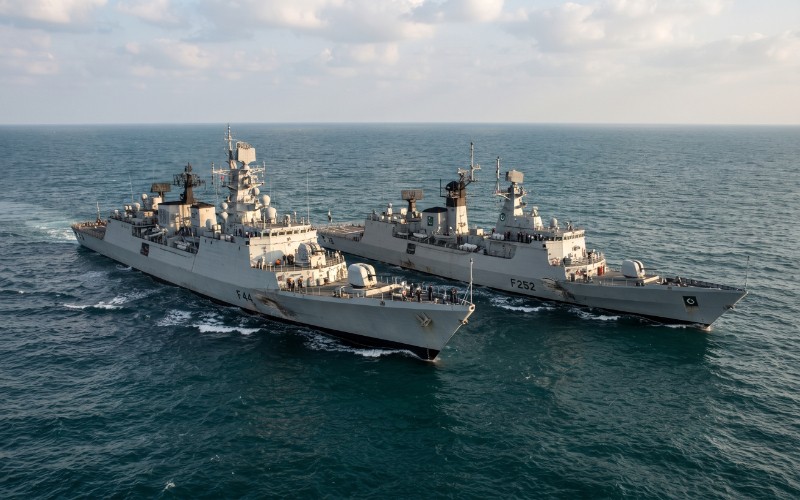
IBNS-CMEDIA: India on Wednesday summoned Pakistan’s Chargé d’Affaires in New Delhi and lodged a strong diplomatic protest after a Pakistani naval unit collided with an Indian Navy vessel in international waters, describing the conduct involved as “unacceptable and unprofessional”.
The Ministry of External Affairs (MEA) said the incident took place in international waters and did not result in any major damage.
However, New Delhi raised concerns over the conduct of the Pakistani naval unit, saying it was in direct contravention of Article 10 of the 1991 Agreement between India and Pakistan on Advance Notice on Military Exercises, Manoeuvres and Troops Movements.
The diplomatic protest comes amid heightened sensitivity surrounding maritime activity in the Arabian Sea and follows earlier instances in which Indian and Pakistani naval vessels have come into close contact.
India lodges strong protest
The MEA said the Pakistani Chargé d’Affaires was summoned and advised to convey India’s concerns to the relevant authorities in Pakistan.
“While the incident, which took place in international waters, did not cause any major damage, the conduct of the Pakistani naval ship was in direct contravention of Article 10 of the Agreement between India and Pakistan on Advance Notice on Military Exercises, Manoeuvres and Troops Movements of April 1991,” the ministry said.
India stressed that military units operating at sea must exercise due care and adhere to bilateral agreements designed to prevent potentially dangerous encounters.
“The Charge d’Affaires of Pakistan was advised to convey to the concerned Pakistani authorities the need for all military units to observe due care and respect the provisions of the relevant agreements between the two sides in order to prevent any repeat of such incidents,” the MEA said.
New Delhi has also instructed its Charge d’Affaires in Islamabad to lodge a similar protest with Pakistan’s Ministry of Foreign Affairs.
Collision took place in international waters
The incident occurred in international waters, with reports identifying the area as the North Arabian Sea.
Indian government sources cited by Indian media said the Pakistani vessel approached the Indian Navy ship at high speed and manoeuvred in what was described as an unsafe and unprofessional manner.
No major damage was reported following the collision.
The MEA, however, focused on the conduct of the Pakistani naval unit and its implications under the bilateral agreement. The ministry’s statement did not indicate that the incident resulted in casualties or significant material damage.
The episode also brings renewed attention to the rules agreed between India and Pakistan to reduce the possibility of military encounters being misread or escalating into larger incidents.
What the 1991 Agreement says
India and Pakistan signed the Agreement on Advance Notice on Military Exercises, Manoeuvres and Troop Movements in New Delhi on April 6, 1991.
The agreement was subsequently ratified and entered into force on August 19, 1992.
The agreement was framed around the need to prevent a crisis arising from the misreading of military intentions and lays down provisions covering land, naval and air forces.
For naval forces, the agreement defines a major military exercise as one involving six or more ships of destroyer or frigate size and above, operating together and crossing into the other country’s Exclusive Economic Zone (EEZ).
It also establishes specific notification requirements for major exercises.
The schedule of major naval exercises involving six or more such ships operating together and crossing into the other country’s EEZ is to be communicated through diplomatic channels in advance.
The agreement further requires the two countries to exchange information concerning major exercises, including their type and level, the general area of operations, planned duration and the number and type of formations involved.
Article 10 and naval safety
Article 10 deals specifically with the distance that naval vessels and submarines belonging to the two countries should maintain while operating in international waters.
It states that naval ships and submarines of the two countries are not to come closer than three nautical miles from each other in order to avoid accidents while operating in international waters.
The provision has previously figured in disputes involving Indian and Pakistani naval vessels.
The current incident has therefore brought renewed focus on a provision that was specifically designed to reduce the risk of accidents involving the naval forces of the two countries operating in international waters.
The agreement also contains provisions concerning military exercises by land and air forces.
For land forces, it sets restrictions and notification requirements for major exercises close to specified areas along the International Border and Line of Control.
Air-force exercises at Regional Command level and above also fall within the agreement’s framework.
Similar naval incident in 2011
The latest collision is not the first occasion on which Indian and Pakistani naval vessels have become involved in a maritime dispute.
In June 2011, a diplomatic row erupted over the MV Suez episode involving the Indian Navy’s INS Godavari and Pakistan Navy’s PNS Babur.
At the time, Pakistani authorities had alleged that the Indian vessel had carried out a dangerous manoeuvre while PNS Babur was escorting the Egyptian-owned merchant vessel MV Suez.
India rejected the allegation and lodged a protest over what it described as unsafe manoeuvring by the Pakistani naval ship.
Then Navy chief Admiral Nirmal Verma said the Pakistani warship had come closer to INS Godavari than was prudent and that the incident resulted in damage to one of the Indian ship’s helicopter nets.
“The Pakistani ship came much closer to our ship than what was prudent to damage one of our helicopter nets…there are clear rules of navigation at sea,” Verma said at the time.
He also described the conduct of the INS Godavari crew as “very professionally” handled.
The 2011 episode also saw both sides invoke navigational safety provisions and the 1991 bilateral agreement.
Diplomatic protest follows maritime encounter
The latest incident has consequently moved beyond a purely naval encounter, with India formally raising the matter through diplomatic channels.
The MEA has called on Pakistan to ensure that its military units exercise due care and comply with bilateral arrangements governing interactions between the two countries’ armed forces.
India has also directed its diplomatic representative in Islamabad to lodge a corresponding protest with Pakistan’s Ministry of Foreign Affairs, ensuring that the issue is formally raised on both sides of the diplomatic channel.