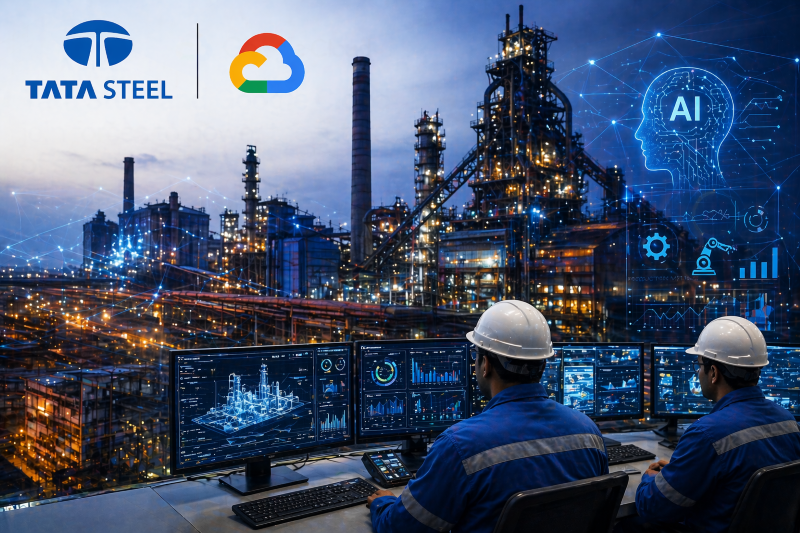
Mumbai/IBNS-CMEDIA: Tata Steel and Google Cloud have announced a major expansion of their strategic partnership to architect the future of steel and advance Tata Steel’s unified, enterprise-wide agentic AI strategy.
Using Google Cloud’s unified technology stack, Tata Steel is rapidly scaling autonomous capabilities across its vast global organisation, successfully deploying a fleet of over 300 specialised AI agents in just nine months to drive efficiency and precision across its global operations.
“Working with Google Cloud has allowed us to turn AI from a technical experiment into a specialised partner for every employee.
“This isn’t just about new tools; it’s about a continuous engine of execution that enables our people to act on insights instantly. From predicting asset maintenance to reducing customer response times, we are using agentic AI to simplify the most complex parts of our business and drive execution at an entirely new scale,” said Jayanta Banerjee, Chief Information Officer, Tata Steel.
Sashi Sreedharan, Managing Director, Google Cloud India, said: “While many industrial players are still navigating the complexities of digital transformation, Tata Steel has moved at unprecedented speed to deploy AI at a scale few in the industry have achieved. Their success demonstrates what is possible when an organisation anchors its strategy in a unified AI and data ecosystem.
“By creating a new blueprint for autonomous business processes at scale, Tata Steel has demonstrated that the synergy between a unified data cloud and generative AI is the key to turning industrial complexity into a distinct, data-driven competitive edge.”
Turning data into a competitive edge
Specialised AI is only as powerful as the decades of operational data that fuels it – and Tata Steel’s early investment in a consolidated data architecture on Google Cloud enabled the Company to move beyond fragmented tools to create a single, enterprise-wide engine for execution. This transformation is driven by two key platforms that bridge the gap between complex data and real-world action:
The first is Zen AI which is empowering a new generation of developers in Tata Steel. This internal low-code platform enables employees who are not data scientists – such as software developers and frontline managers – to build, test, and deploy their own specialised AI agents.
Built using Google Cloud’s Agent Development Kit (ADK) and integrated with BigQuery and Google Cloud Storage, Zen AI unifies decades of structured operational data with unstructured sources like video and documents within a secure, governed framework.
This in turn has transformed Tata Steel’s global workforce into a distributed engine of innovation, where small, agile teams can now deploy enterprise-grade AI solutions with speed and precision that rivals the most nimble technology disruptors.
The second is the Tata Steel Digital Assistant (TDA) – a sophisticated internal portal that synthesises once-siloed information into a single interface, acting as a command center for decision making. With the ability to query data across three distinct domains – global public data, internal enterprise systems (such as operational APIs, SOPs, and financial records), and proprietary user data (including call recordings, complex spreadsheets, and PDFs) – TDA allows employees to navigate volatility with unprecedented precision.
For example, by layering real-time global news and geopolitical sentiment over traditional commodity price data, the AI agents can provide predictive market intelligence, helping the Company stay ahead of supply chain shifts and market fluctuations. By turning data like call recordings and PDFs into actionable insights, Tata Steel is also transforming its vast organisational knowledge into a distinct, data-driven competitive advantage.
Driving organisational efficiency and transforming employee experience with AI
Tata Steel is also using agentic AI to eliminate administrative bottlenecks and reshape how the Company manages internal operations. For example, TDA assists the internal HR helpdesk in resolving more than 70% of routine employee tickets autonomously, saving hours of time for individuals across teams.
This efficiency further extends into core business functions through a dedicated fleet of business process agents. These agents work in harmony to streamline complex back-office workflows, including intelligent invoice processing, goods and services tax (GST) creditable/non-creditable classifications, and specialised contract analysis. By automating these repetitive, manual tasks, Tata Steel is easing the strain on teams across the organisation and allowing them to focus on high-value strategic initiatives.
Tata Steel’s agentic deployments are underpinned and supported by a scalable infrastructure built on Google Cloud Run. This enables the system to handle demand spikes instantly while scaling to zero when idle. With access to over 200 models on Google Cloud’s AI Agent Platform, Tata Steel ensures the optimal AI model is matched to every task, while also maintaining strict lifecycle management and governance.
AI-driven safety and operational excellence on the shop floor
Beyond administrative tasks, this agentic ecosystem is driving immediate impact across the manufacturing floor, where safety remains the highest priority. By integrating AI directly into industrial workflows, the Company has shifted from traditional monitoring to proactive, real-time intervention.
Central to this is Safety EyeQ, a specialised agent that analyses live video feeds in high-risk zones to ensure strict adherence to Standard Operating Procedures (SOPs). By identifying hazards – such as moving large equipment in proximity to hot material or any SOP deviation – the agent provides complete situational intelligence & triggers real-time alerts for immediate corrective action.
This intelligence extends across the value chain through Asset Sphere agents, which evaluate equipment health to provide proactive maintenance plans, preventing unplanned downtime.
This multimodal approach leverages Google’s Large Language and Vision–Language Models such as Gemini and Palli Gemma.
The same engine is also enhancing customer service, where specialised agents now automatically analyse complaint artifacts to detect complaint intent and defects from images and route issues to resolver groups, successfully reducing average turnaround time by 50%.