Library of Congress. Image credit: Facebook page of Library of Congress
Washington/CMEDIA: Founded in 1800, The Library of Congress (LoC) has reportedly been through numerous major technological revolutions ever since Artificial intelligence (AI) started transforming society and institutions worldwide.
Some of the technological transformations include pneumatic tubes and telephones, printed card catalogs and talking books, machine-readable records and automation, computer terminals, digitization, data storage, the internet, mobile devices, and APIs.
The implementation of AI is similar in some ways to previous technological and digital transformations, while in others, it is unlike anything that has come before.
With the rapid improvement of AI technologies, the LoC is engaging with them calls on its history and a strong foundation of IT security and governance.
Focusing on embracing new technologies with care, LoC’s strategy to build on decades of technological innovation, and balancing human judgment with machine capabilities.
The largest library in the world now, LoC’s mission is to “engage, inspire, and inform Congress and the American people with a universal and enduring source of knowledge and creativity.” The Library’s approach to AI considers the road traveled through previous technology revolutions to inform this strategy.
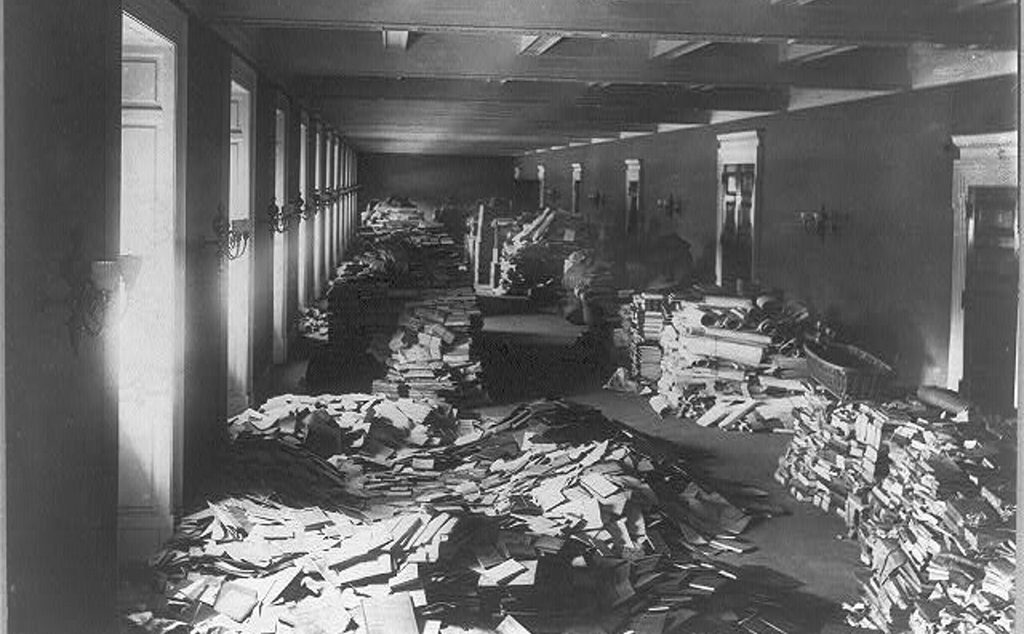
Copyright Deposits in the Basement Before Classifying. Washington D.C, 1898. [?] Photograph. https://www.loc.gov/item/2007681329/. Image credit: Library of Congress
The turn of the 19th century saw the Library’s holdings fit in the north wing of the U.S. Capitol, acting as a small Congressional library. The growth of the collections in the early decades of the 20th century saw progress in cataloging, research, and service to Congress through the Legislative Reference Service.
Copyright Deposits in the Basement Before Classifying. Washington D.C, 1898. [?] Photograph. https://www.loc.gov/item/2007681329/. Image credit: Library of Congress
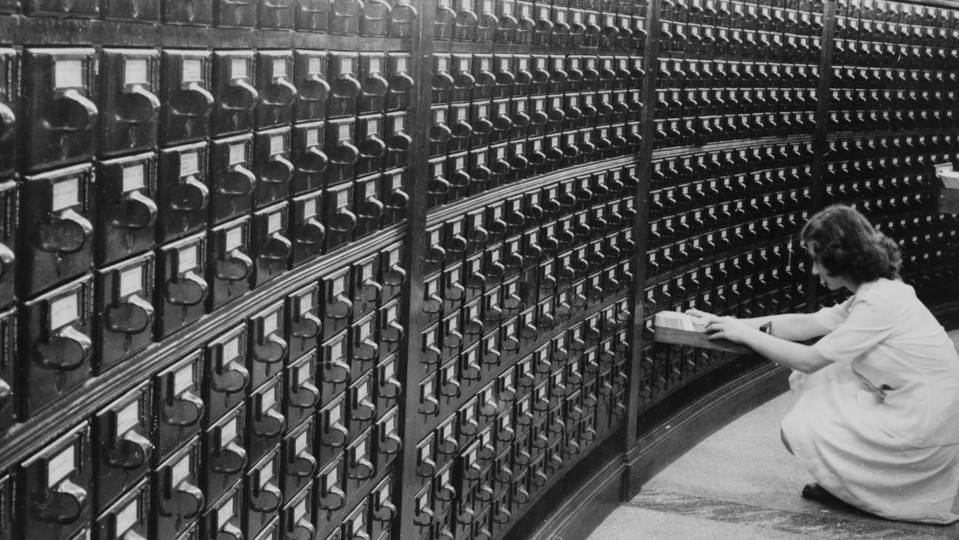
In the 20th century, with the adoption of new technologies, the Library adopted — book movers, pneumatic tubes, and telephones among them. Even more innovations, including typed catalog cards, talking books, the classification system, accessible materials, and other methodologies, were shared with people across the country.
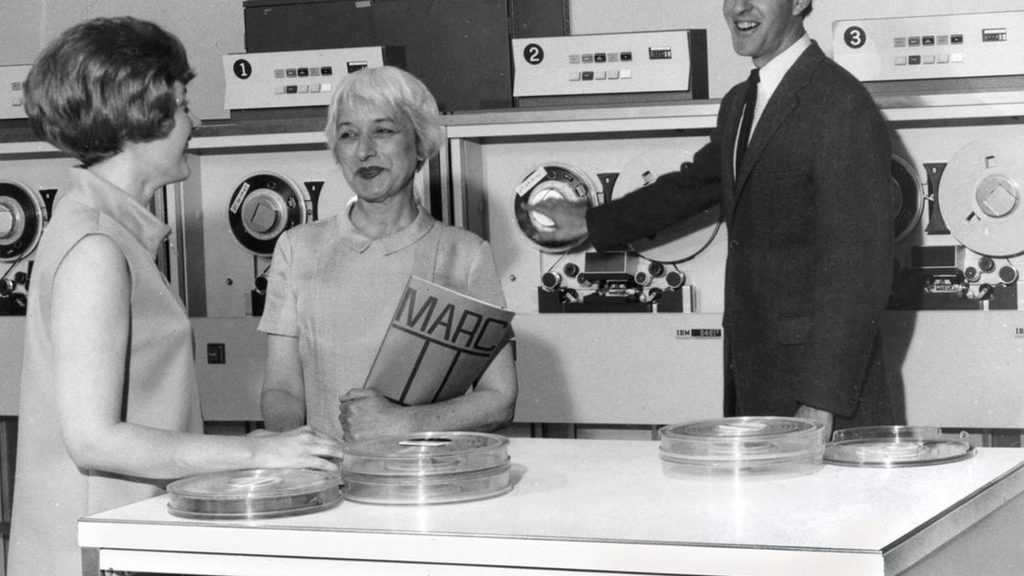
Henriette Avram (center) talks to colleagues at the launch of the MARC Pilot Project in 1966. Source: Library of Congress Archives as cited in LC Magazine. Image credit: Library of Congress
Although computers, networks, and big data fundamentally changed the Library’s work, later in the 20th century the library’s mission remained unchanged. The ability to automate aspects of preservation, storage, and access led to innovations in data processing, machine-readable catalog records, and the distribution of new iterations of accessible materials.
The library saw a big change in the way it converted Library materials to digital records and the establishment of new ways of distributing these materials. Library’s goal of serving Congress and the American public further expanded with the advent of the internet allowing users in Washington, D.C. and around the world to engage with the collections via an online catalog, programming, and other modes of outreach.
A massive proliferation in both data and use of the Library’s collections with more than 179 million items and over 200 petabytes of data, the digital era ushered a growth through daily receipt of both physical and born digital materials. Each year the Library’s web properties were exp;ored by nearly 180 million unique visitors.
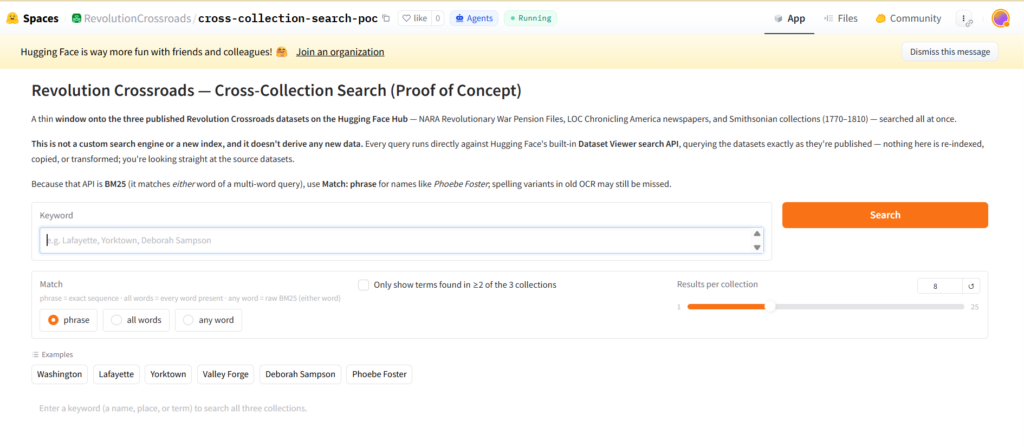
Screenshot from the proof of concept tool created as part of the Smithsonian-Library of Congress Revolution Crossroads collaboration to search three Revolutionary-era collections with one keyword. https://huggingface.co/RevolutionCrossroads. Image credit: Library of Congress
Multiple points of access, support for programs and opportunities, and major, enduring initiatives like loc.gov and congress.gov happened with large, varied materials, the Library’s service to Congress and the American people in the 21st century.
Taking advantage of the opportunities afforded by new technologies since its inception, the Library’s Strategic Plan fully integrated digital strategy for the first time which includes strengthening of capacity and foster innovation and the user-centric goals to expand access and enhance services facilitating the introduction and use of responsible AI.
AI techniques at the Library include processing of collections Like Optical Character Recognition (OCR), handwriting recognition, computer vision, transliteration and translation, and generative metadata, staff and user support like natural language processing for workflows, speech-to-text, text-to-speech, text summarization, recommendation systems, and voice-based discovery, and research and data analysis like text mining and analysis, data classification.