
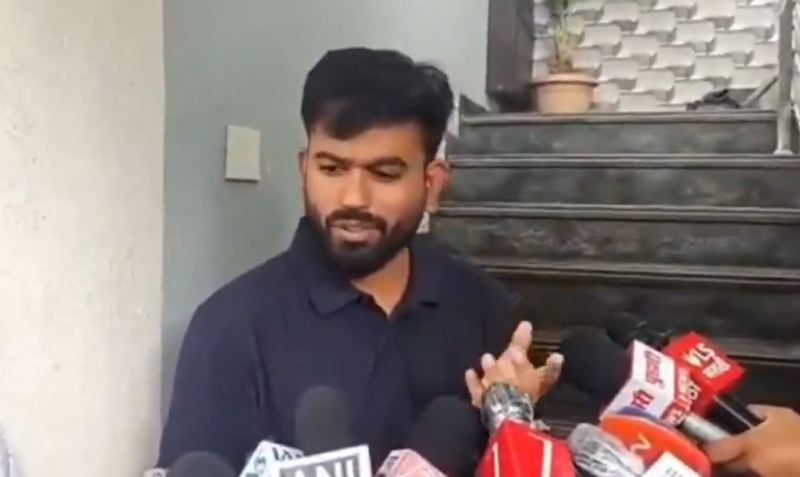
New Delhi/IBNS-CMEDIA: Cockroach Janta Party (CJP) founder Abhijeet Dipke on Thursday alleged that he had received threats to join the Bharatiya Janata Party (BJP), days after the massive NEET paper leak protests culminated in the resignation of Union Education Minister Dharmendra Pradhan.
Speaking to the media, Dipke claimed that he was pressured to join the ruling party and that the offer was accompanied by threats directed at him and his family.
“I received numerous threats to join the BJP for the well-being of both myself and my family,” he alleged.
Referring to Prime Minister Narendra Modi and Union Home Minister Amit Shah, Dipke said, “I am the same age as the grandchildren of Prime Minister Narendra Modi and Union Home Minister Amit Shah. If someone my age is receiving threats, then what is the purpose of the power they hold?”
अभिजीत दीपके: BJP की तरफ़ से उन्हें पार्टी में शामिल होने का ऑफर धमकियों के साथ मिला,
उनके मुताबिक कहा गया कि BJP जॉइन कर लो तो उनके और उनके परिवार की ज़िंदगी बेहतर हो जाएगी।
इस पर अभिजीत ने कहा, मैं मोदी और अमित शाह के पोते-पोतियों की उम्र का हूँ अगर बच्चों को धमकाना पड़े तो… pic.twitter.com/n4maLp0Acq
— Cockroach Janta Party (@CJP_for_India) July 30, 2026
Dharmendra Pradhan’s resignation
Dharmendra Pradhan resigned as the Union Education Minister on July 25, 2026, amid mounting nationwide protests over alleged irregularities in the NEET examination.
The controversy triggered widespread outrage among students, parents and opposition parties, leading to sustained demands for accountability and Pradhan’s resignation.
Following the political fallout, the Centre initiated a series of reforms aimed at strengthening the integrity of public examinations and appointed a new Union Education Minister.
Anti-Paper Leak law strengthened
In a major legislative move, the government this week tabled the Public Examinations (Prevention of Unfair Means) Amendment Bill, 2026, commonly referred to as the Anti-Paper Leak Amendment Bill in the wake of the protest.
The bill has already been passed by Lok Sabha, the lower house of Parliament.
The legislation introduced stricter penalties for examination fraud, including tougher jail terms and higher fines for those involved in paper leaks and organised cheating rackets.
It also provides for Special Task Forces, time-bound investigations and fast-track courts to expedite the prosecution of offences related to public examinations.