
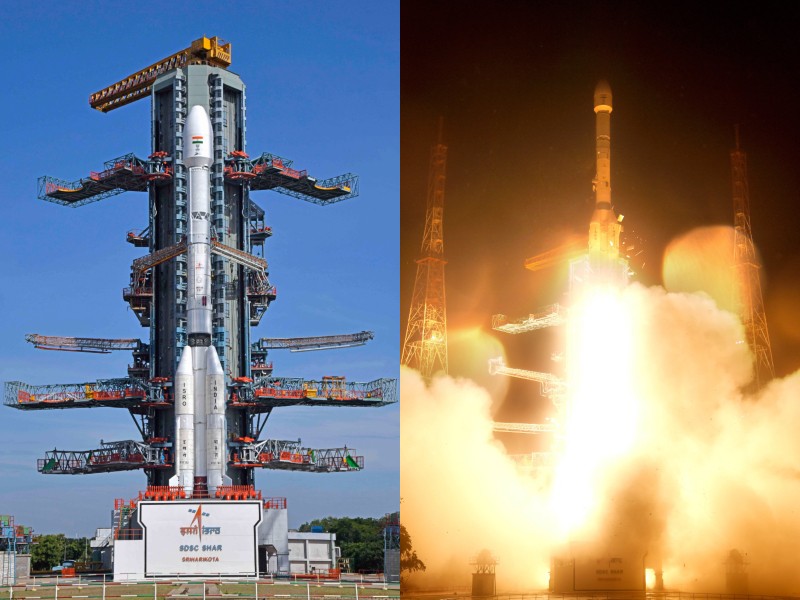
IBNS-CMEDIA: At 2:55 am on Friday (September 4), when most of India was still asleep, the countdown at Sriharikota reached its defining moment — GSLV-F17 thundered into the dark sky carrying EOS-05, an advanced Earth observation satellite designed to operate from geosynchronous orbit.
About 18 minutes later, the Indian Space Research Organisation (ISRO) had another reason to breathe easier.
The 2,367-kg satellite had been precisely injected into its intended sub-geosynchronous transfer orbit, marking the successful 19th flight of the GSLV and the 107th launch from Sriharikota.
The achievement came after a difficult period for India’s launch programme and gave the GSLV Mk II, often referred to as ISRO’s “Naughty Boy”, another important chapter in its complicated history.
A crucial success after PSLV setbacks
The GSLV-F17 mission was more than another launch on ISRO’s busy calendar. It came after consecutive setbacks involving the agency’s workhorse PSLV.
The PSLV-C61 mission carrying EOS-09 failed in May 2025 after an anomaly in its third stage.
The next PSLV mission, C62, carrying EOS-N1 and 15 other payloads, encountered another anomaly during the third stage on January 12, 2026.
ISRO subsequently initiated a detailed investigation into the problem.
Against that backdrop, the successful GSLV-F17 flight assumed particular significance.
It demonstrated that another member of ISRO’s launch fleet could deliver a demanding payload accurately while the agency continued working through the problems affecting the PSLV.
The GSLV itself has had a turbulent journey.
Its earlier failures earned it the affectionate but slightly nervous nickname “Naughty Boy”.
Yet the vehicle has also become an important part of India’s effort to develop independent access to heavier satellite-launch capabilities.
Mission Success!
GSLV-F17 has successfully accomplished its mission, placing EOS-05 into the intended orbit.
Sharing a few memorable moments from the lift-off.
For more information:https://t.co/VneB2jgZoY#GSLVF17 #EOS05 #ISRO pic.twitter.com/kv0zB6V5Vi
— ISRO (@isro) September 3, 2026
Difficult road to mastering cryogenic technology
The GSLV story is closely linked to one of the most difficult technologies in modern rocketry: the cryogenic engine.
India needed cryogenic propulsion to launch heavier communication satellites into higher orbits.
During the 1990s, it sought assistance from Russia, but technology-transfer restrictions and geopolitical pressure complicated those plans.
India eventually received a limited number of cryogenic engines but did not obtain the complete technology it had originally sought.
The setback pushed ISRO towards developing the technology domestically.
It took years of research, testing, failures and incremental improvements before India established an indigenous cryogenic capability.
That long effort eventually turned the GSLV Mk II into one of the country’s key launch vehicles.
Its subsequent missions demonstrated that India had moved from being dependent on imported technology to developing critical propulsion systems at home.
From failed GISAT mission to EOS-05
The significance of EOS-05 also lies in the history of the satellite itself.
In August 2021, ISRO attempted to launch GISAT-1 aboard GSLV-F10.
The mission was intended to place an Earth observation satellite in a high orbit capable of providing frequent imaging of the Indian region.
However, the mission failed after an anomaly involving the cryogenic upper stage.
ISRO’s official mission record lists GSLV-F10/EOS-03 as unsuccessful.
EOS-05, also known as GISAT-1A, represents the next attempt to realise that broader objective.
This time, the GSLV-F17 completed its mission successfully.
The satellite was placed into a sub-geosynchronous transfer orbit, from where it will use its own propulsion system and manoeuvres to reach its final operational orbit.
New ‘eye in the sky’
EOS-05 is India’s first imaging satellite designed to operate from a geosynchronous orbit.
Once it reaches its final operational position, roughly 36,000 km above Earth, it will be capable of repeatedly observing a broad region rather than passing over the same location only at intervals.
That distinction is important.
Most conventional Earth observation satellites operate in lower orbits and provide periodic snapshots as they pass over particular areas.
EOS-05 is designed to provide much more persistent coverage of India and surrounding regions.
The satellite is expected to support applications including weather monitoring, disaster management, agriculture, forestry, environmental observation and infrastructure monitoring.
Its ability to repeatedly image large areas could also be valuable during rapidly developing events such as cyclones, floods and forest fires.
DK Singh, Director of the UR Rao Satellite Centre in Bengaluru, where the spacecraft was developed, described EOS-05 as another “eye in the sky”.
The satellite also has relevance for strategic surveillance. Its persistent observation capability can contribute to maritime awareness and national security alongside its civilian applications.
GSLV carries its heaviest payload in this class
The mission also marked an important achievement for the GSLV itself.
At 2,367 kg, EOS-05 is the heaviest satellite so far launched by a GSLV-class rocket into a sub-geosynchronous transfer orbit.
The vehicle’s performance exceeded expectations, giving the satellite a higher apogee than originally planned.
ISRO Chairman V Narayanan described the mission as a major achievement and said the spacecraft was healthy after separation.
The satellite has not yet reached its final geostationary operating position. It will undertake further orbit-raising manoeuvres before entering its intended operational orbit.
NISAR success had already shown the GSLV’s capability
The GSLV-F17 mission also follows another significant achievement for the launch vehicle family.
In July 2025, GSLV-F16 successfully launched NISAR, the joint NASA-ISRO Synthetic Aperture Radar satellite.
The mission placed the spacecraft into a 743-km Sun-synchronous orbit and became an important demonstration of the GSLV’s ability to handle a sophisticated, high-value payload.
NISAR subsequently entered its science phase and became fully operational, according to ISRO.
EOS-05 now adds another milestone to that record, this time involving a satellite specifically designed for imaging from geosynchronous orbit.
‘Reward for hard work is more work’
The celebration at Sriharikota was brief because ISRO’s schedule leaves little room for a long pause.
Narayanan summed up the immediate task after the successful mission with the words: “Reward for hard work is more work.”
ISRO has targeted six more launches during the current financial year, including the NVS-03 navigation satellite.
The agency is also continuing preparations for the first uncrewed mission under the Gaganyaan programme, which Narayanan said remains targeted for launch during 2026.
The Gaganyaan mission will be a much bigger test, involving a human-rated launch vehicle and the systems required for India’s eventual crewed spaceflight programme.
For now, however, GSLV-F17 has delivered exactly what ISRO needed from it.
It has successfully carried EOS-05 into its intended transfer orbit, restored momentum following the recent PSLV setbacks and advanced India’s ability to conduct persistent Earth observation from a much higher vantage point.
The “Naughty Boy” has once again shown why, despite its complicated history, it remains an important part of India’s space programme.