
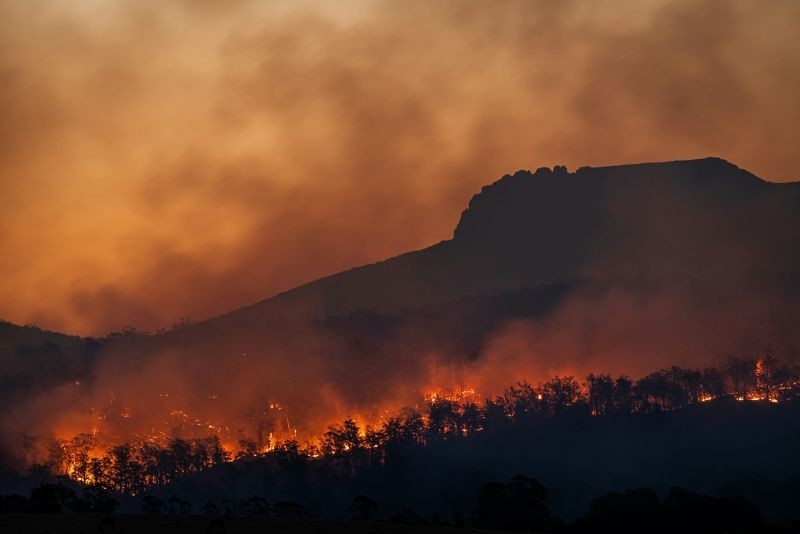
IBNS-CMEDIA: At least 12 people were killed after a fast-moving wildfire swept through Spain’s southern Andalusia region, marking the deadliest blaze recorded in the region, according to media reports. Authorities have not yet confirmed the cause of the fire.
Regional officials said on Friday that the wildfire had claimed at least 12 lives, while 19 people remained missing, raising fears that the death toll could rise further, Al Jazeera reported.
The tragedy comes as Spain grapples with soaring temperatures amid a wider European heatwave.
“The number of people who died in the fire in Los Gallardos has risen to 12 after the confirmation of six more deaths,” the regional government said in a statement, as quoted by Spain English.
Regional emergency chief Antonio Sanz described the disaster as “an unprecedented tragedy,” adding that “the pain is immense.”
Witnesses told authorities that the blaze may have been triggered after a power line fell onto dry vegetation, igniting the surrounding woodland. However, officials have not confirmed the cause.
Spanish Prime Minister Pedro Sánchez expressed his condolences in a post on X, writing: “Immense sadness and desolation in the face of the terrible consequences of the fire affecting the province of Almería.”
Europe scorched by record-breaking heat
The disaster comes during a year in which several European countries have been battered by extreme heat and prolonged heatwaves.
According to the Copernicus Climate Change Service (C3S), June 2026 was the hottest June ever recorded in western Europe and the second warmest globally.
The climate monitoring agency said Europe experienced exceptionally high temperatures over both land and sea, with much of western Europe enduring a record-breaking heatwave. Marine heatwaves also developed across the western Mediterranean and along the Atlantic coastline.
Globally, the average sea surface temperature (SST) for the extra-polar oceans (60°S–60°N) reached a record high for June, surpassing the previous record set in June 2024 by 0.01°C. Scientists attributed the rise partly to the development of strong El Niño conditions in the equatorial Pacific.
C3S warned that the succession of intense heatwaves underscores the growing challenge posed by increasingly frequent and severe heat extremes driven by climate change.
The agency also noted that widespread dryness across Europe, combined with extreme temperatures, fuelled wildfire activity, particularly in the Iberian Peninsula and southern France, while worsening drought conditions in parts of eastern Europe.
June’s heatwave occurred against a backdrop of increasingly dry soils across western and central Europe, further intensifying drought conditions that had already begun during May’s heatwave, the service added.
Climate change driving wildfire risks
According to the World Resources Institute (WRI), wildfires are associated with the loss of around 163 million hectares of tree cover globally.
The organisation says climate change is becoming an increasingly significant driver of forest loss by intensifying droughts, heatwaves and storms, making forests more vulnerable to fires, pests and diseases.
While all forests face rising fire risks, wildfires had particularly severe impacts in boreal and temperate regions in 2025. Fires accounted for 42% of the 25.5 million hectares of global tree cover loss last year—an area larger than the United Kingdom, WRI said.
The UN Office for Disaster Risk Reduction (UNDRR), citing global reinsurer Munich Re, said natural hazards caused an estimated USD 224 billion in economic losses worldwide in 2025, of which USD 108 billion was insured.
The costliest single disaster was the Los Angeles wildfires, which killed 30 people and caused an estimated USD 53 billion in damages, including USD 40 billion in insured losses.
According to the 2025 Global Assessment Report on Disaster Risk Reduction (GAR 2025), wildfires are among the world’s most economically destructive natural hazards. Between 2014 and 2023, they caused an estimated USD 106 billion in economic losses and USD 74 billion in insured losses globally—far exceeding the losses recorded during the previous decade.
The Palisades and Eaton wildfires that swept through the Los Angeles area in January 2025 destroyed thousands of structures and forced the evacuation of more than 100,000 people.
In India, at least five people died in a wildfire in Uttarakhand in 2024.
Wildfires also inflict devastating ecological damage. According to WWF Australia, more than 60,000 koalas were among the animals affected during Australia’s catastrophic bushfires in late 2019.