IBNS-CMEDIA: India has reaffirmed its commitment to strengthening international scientific collaboration by announcing an investment of more than 7 million euros over the next five years, beginning in 2026-27, to support the redevelopment of research beamlines at Italy’s Elettra Sincrotrone Trieste under the Elettra 2.0 programme.
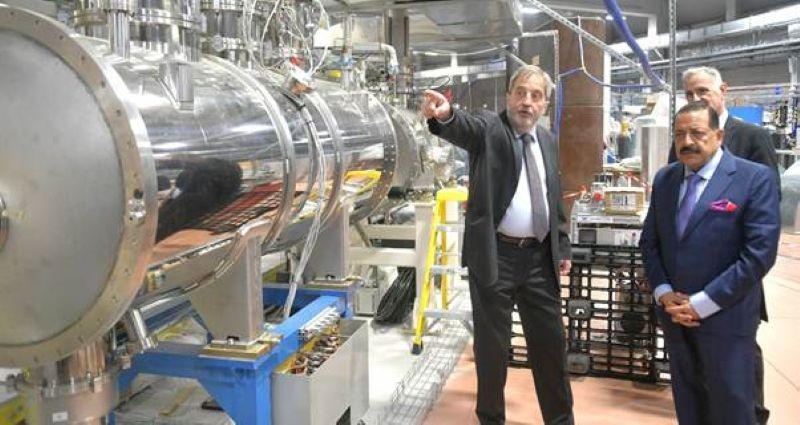
The announcement was made by Union Minister of State (Independent Charge) for Science and Technology and Earth Sciences, Dr Jitendra Singh, during his visit to Elettra Sincrotrone Trieste on November 13, 2026.
India’s participation as a co-partner in the initiative will support the development of advanced research infrastructure and human resource capabilities, marking a new phase in the longstanding scientific partnership between India and Italy.
The upgraded facilities are expected to create new research opportunities in Chemistry, Physics, Advanced Materials, Structural Biology and several other scientific disciplines, benefiting researchers from India and other countries.
India’s participation in Elettra 2.0 builds on more than 25 years of scientific collaboration between Indian research groups and the Italian facility. Indian scientists have been conducting experiments at Elettra since 1998 and continue to make extensive use of its research infrastructure.
India is currently the second-largest user of Elettra after Italy, highlighting the sustained engagement of the Indian scientific community with the facility.
The scale of this collaboration is reflected in the more than 1,100 experimental proposals submitted by Indian research groups. India ranks second in the number of proposals, behind Italy, which has submitted 54,140 proposals, and ahead of France, with 1,098 proposals.
Under the Elettra 2.0 programme, the existing India-centric XRD2 and Xpress beamlines will be decommissioned and replaced with two upgraded facilities offering enhanced research capabilities. These will include a microfocus beamline for macromolecular crystallography, named micro-XRD (μXRD), and a high-pressure diffraction beamline called Xpress Superbend (Xpress-SB).
The redevelopment builds on India’s earlier investment in dedicated research infrastructure at Elettra. The Department of Science and Technology (DST), along with its Italian counterpart, had jointly supported the construction of the two existing advanced diffraction beamlines, XRD2 and XPRESS, with an Indian contribution of approximately Rs 22 crore.
Both beamlines were jointly inaugurated on October 20, 2016, during a visit to Italy by the Secretary of the Department of Science and Technology.
Since their commissioning, the facilities have been extensively used by Indian researchers, with approximately 50-60 Indian scientists travelling to Trieste every year to conduct experiments.
The DST has also facilitated access to Elettra for Indian researchers through the Indo-Italian Executive Programme of Cooperation (EPOC).
Under EPOC 2022-2024, the department sanctioned Rs 2 crore over three years to support visits by 50 Indian researchers annually. The programme provided for 25 visits in each semester, enabling scientists to conduct experiments using allocated shifts at Elettra beamlines.
The EPOC 2025-2027 programme also includes a proposal to support Indian researchers conducting experiments at the facility, with a proposed allocation of Rs 1.5 crore over three years.
The DST had earlier conveyed its agreement to participate in the redevelopment of the India-centric beamlines under Elettra 2.0, with a Letter of Intent (LoI) signed in this regard. During his latest visit, Dr Jitendra Singh reaffirmed India’s commitment to the initiative by announcing the investment of more than 7 million euros over five years.
India’s participation will build on the experience gained through the successful development and utilisation of the existing beamlines while supporting the creation of upgraded research infrastructure for the next phase of scientific cooperation between the two countries.
Through its involvement in Elettra 2.0, India aims to further strengthen its scientific partnership with Italy and expand research opportunities for Indian and international scientists in advanced and specialised areas of science and technology.