Kolkata/IBNS-CMEDIA: Former West Bengal Chief Minister Mamata Banerjee’s political journey has come full circle in Nandigram, with the Trinamool Congress founder backing a Congress candidate for the October 6 bypoll and describing the grand old party as a “natural ally” — a phrase she had famously used for the Bharatiya Janata Party (BJP) more than two decades ago.
In a striking political contrast, Mamata had described the BJP as her “natural ally” during a 2001 interview with Karan Thapar, when she was in the opposition in West Bengal and the Trinamool Congress was still a relatively young political force.
From Congress leader to TMC founder
Mamata began her political career with the Congress in the 1970s and rose through the Youth Congress.
In 1984, she was elected to the Lok Sabha from Jadavpur, defeating veteran CPI(M) leader Somnath Chatterjee. She returned to Parliament from Kolkata South in 1991 and subsequently served as a Union Minister.
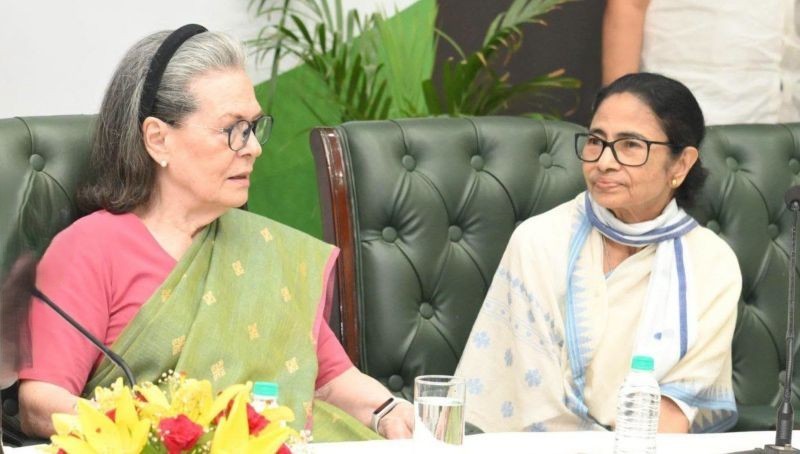
 Mamata Banerjee addressing a press conference at her Kalighat residence on September 18. Photo: Avishek Mitra/IBNS
Her relationship with the Congress leadership deteriorated through the 1990s over differences concerning the party’s strategy in Bengal and its approach towards the Left Front.
Mamata eventually broke away from Congress and founded the All India Trinamool Congress in 1998, turning the new party into the principal challenger to the Left Front in West Bengal.
From Congress breakaway to BJP ally
The early years of the Trinamool Congress also saw an alliance with the BJP. The party joined the BJP-led NDA and Mamata served as Union Railway Minister in the Atal Bihari Vajpayee government.
It was against this political backdrop that Mamata, in her 2001 conversation with Karan Thapar, described the BJP as a “natural ally” while explaining her opposition to supporting the CPI(M) and Congress.

Congress and TMC crossed paths again
Mamata’s political relationship with Congress, however, was never a straight line of opposition.
The TMC allied with Congress in the 2001 West Bengal Assembly election and later joined hands with the party for the 2009 Lok Sabha election.
The two parties subsequently fought the 2011 Bengal Assembly election together, helping bring an end to the Left Front’s 34-year rule.
After Mamata became Chief Minister in 2011, the relationship again deteriorated and the two parties returned to competing political spaces in Bengal.
Nandigram brings the relationship full circle
The latest turn came after Mamata’s faction fielded Sanchita Pradhan Dey as its candidate for the Nandigram bypoll.
Dey withdrew her nomination on Friday after meeting West Bengal Chief Minister Suvendu Adhikari. Mamata subsequently announced that her faction would not field another candidate and would support Congress nominee Milan Pradhan.
Mamata described Congress as a “natural ally” while framing the decision in the context of opposition unity and the INDIA bloc.
“We can support a natural ally but not the nasty, dirty, tricky and high-loaded virus,” she remarked at a press conference at her Kalighat residence on Friday.

The development is particularly significant because TMC and Congress have generally contested elections separately in Bengal in recent years, despite their participation in the broader INDIA bloc at the national level.
The move also came amid a major organisational crisis within the Trinamool Congress. The Election Commission has frozen the use of the original All India Trinamool Congress name and its traditional symbol amid the dispute between rival factions.
Mamata’s faction has been allotted the interim name Mamata All India Trinamool Congress and the football player symbol, while the rival faction has been allotted a separate name and symbol.
A political circle — but not necessarily a permanent alliance
The Nandigram development creates an unusual political symmetry: Mamata began as a Congress leader, broke away to establish the Trinamool Congress, spent periods in alliance with both Congress and the BJP, and eventually emerged as one of the BJP’s principal opponents in Bengal.
Now, decades after leaving Congress, she is backing a Congress candidate in Nandigram and speaking of the party as a “natural ally”.
Asked whether an alliance with Congress could be the way forward for the 2029 Lok Sabha elections, Mamata told IBNS, “Yes of course, why not? This is the beginning. We want to see the end of the BJP era.”

However, the latest move by itself does not establish a permanent Congress-TMC alliance.
Mamata has spoken of broader opposition coordination, while Congress and TMC have had a complicated relationship in Bengal, including periods of direct electoral competition.
The immediate development is the decision to support Congress in the Nandigram bypoll.
The episode therefore marks another turn in Mamata’s long and frequently changing relationship with Congress — with Nandigram once again serving as the backdrop to a major shift in Bengal’s political equations.
The development took another turn hours later when Congress candidate Milan Pradhan was arrested in connection with a 2007 case linked to the Nandigram land-acquisition agitation.
Congress criticised the arrest, while police cited pending warrants in the case.
(Photos by Avishek Mitra/IBNS & AITC Facebook page)