
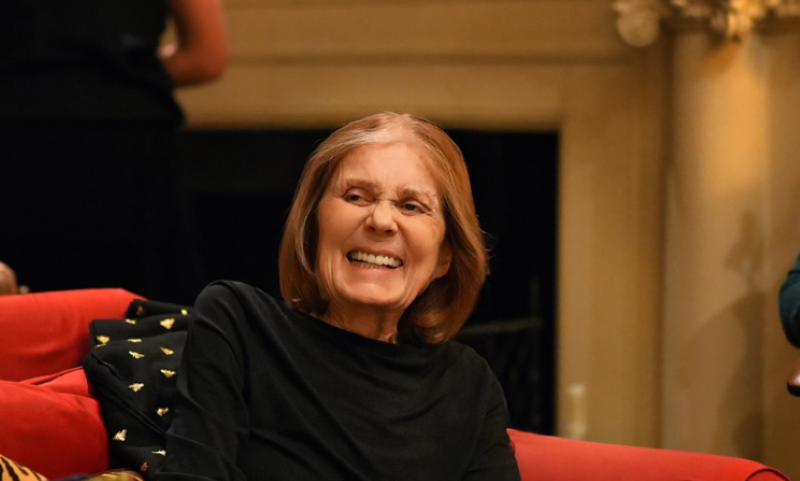
IBNS-CMEDIA: Gloria Steinem, the celebrated American journalist, author and women’s rights activist who became one of the defining figures of the second-wave feminist movement, has died at the age of 92.
Steinem died peacefully at her home in New York City, according to a statement shared through her verified Instagram account.
The statement said she remained committed to the cause of equality throughout her life and continued working until the end.
“Gloria’s near-century on earth were years well-lived,” the statement said, remembering a woman whose influence extended far beyond journalism and into American politics, social activism and the broader struggle for gender equality.
Those close to Steinem described her ability to listen and make people feel understood as one of her greatest qualities. Her words, activism and example, they said, encouraged people to live more freely and authentically.
A childhood that shaped her outlook
Born on March 25, 1934, in Toledo, Ohio, Steinem was the second daughter of Leo and Ruth Steinem.
Her father was a travelling salesman, while her mother suffered from mental illness. Her parents separated in 1944, and the young Steinem spent part of her early life helping care for her mother.
After Steinem completed high school, her elder sister returned to Toledo to look after their mother, allowing Gloria to pursue higher education.
She enrolled at Smith College in Massachusetts, where she studied government and graduated magna cum laude in 1956.
A Chester Bowles Fellowship subsequently took her to India, where she spent two years studying and researching.
Her time in India had a lasting impact on her worldview. The experience exposed her to grassroots activism and helped shape the approach to social change that would later become central to her work in the United States.
According to reports, she stayed for a significant amount of time at the Miranda House hostel in Delhi.
During her stay in the South Asian country, which significantly influenced her understanding of feminism and introduced her to grassroots organising among followers of Mahatma Gandhi, she travelled to Kolkata (then Calcutta), Southern India and even Mumbai (then known as Bombay).
From journalism to the feminist movement
Steinem began her career as a freelance journalist in New York at a time when the American media industry remained overwhelmingly male-dominated.
Women journalists were frequently assigned to so-called “women’s pages”, which concentrated largely on fashion, lifestyle and domestic issues rather than politics and public affairs.
Steinem pushed against those limitations.
Her reporting increasingly examined discrimination, women’s rights and social inequality, eventually establishing her as one of America’s most prominent political writers and feminist voices.
Her work helped bring issues that had often been treated as private or peripheral into mainstream political debate.
Steinem became particularly influential during the rise of the women’s liberation movement in the late 1960s and 1970s. Her writing, public appearances and activism helped make feminism a central issue in American political and social life.
Building organisations for women’s equality
Steinem’s influence extended well beyond journalism.
In 1971, she joined Congresswoman Bella Abzug, Congresswoman Shirley Chisholm, activist Fannie Lou Hamer and feminist leader Betty Friedan in establishing the National Women’s Political Caucus.
The organisation sought to increase women’s participation in American politics and support candidates committed to gender equality.
Steinem also helped establish several other organisations during her long career, including the Women’s Action Alliance, Voters for Choice, the Ms. Foundation for Women and the Women’s Media Center.
The organisations reflected her belief that lasting social change required not only public campaigning but also institutions capable of supporting future generations.
In the 1990s, she was also involved in the creation of Take Our Daughters to Work Day, an initiative designed to expose girls to different professions and encourage them to consider possibilities beyond traditional gender roles.
A lifelong campaign for equality
For decades, Steinem remained one of the most recognisable figures in the American feminist movement.
She campaigned for reproductive rights, equal opportunities for women, political representation and the Equal Rights Amendment, while using journalism and public advocacy to challenge discrimination against women.
Her influence reached several generations of activists and political leaders.
Despite the changing political landscape, Steinem continued to speak publicly about equality and remained an important figure in debates surrounding women’s rights.
Tributes from America’s political and cultural leaders
News of Steinem’s death prompted tributes from prominent American figures who credited her with helping reshape the country’s understanding of gender equality.
Former US Vice President Kamala Harris remembered Steinem as a “trailblazing activist, organizer, and journalist” and an enduring icon.
Harris recalled meeting Steinem in the late 1990s, when Harris was a young prosecutor working on crimes involving women and children and had co-founded an organisation called Women Count.
She described Steinem as kind, intelligent and witty, while highlighting her commitment to encouraging younger women to enter leadership roles.
Harris also recalled Steinem’s support for women seeking elected office, including Harris’s own presidential campaign.
Former US Secretary of State Hillary Clinton also paid tribute to Steinem, recalling how her emergence as a prominent feminist voice in the 1960s and 1970s influenced the way an entire generation viewed women’s aspirations.
Clinton called Steinem one of the architects of the broader movement for women’s equality.
Media icon Oprah Winfrey, in a Facebook tribute, said Steinem had left behind a world with greater freedom than the one she inherited.
Gloria Steinem was a fearless trailblazer who transformed the fight for equality in America and inspired generations of women to know their power.
Her voice, courage and relentless advocacy helped break down barriers and open doors once firmly closed to women.
May it be a… https://t.co/6Kcu1HzqP0
— Nancy Pelosi (@SpeakerPelosi) September 3, 2026
Former US House Speaker Nancy Pelosi remembered Steinem as a fearless pioneer whose activism transformed the struggle for equality and inspired generations of women.