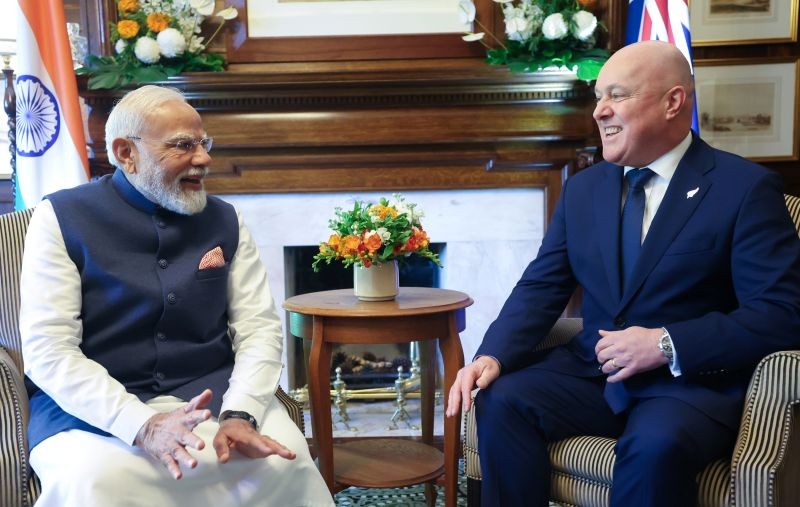
IBNS-CMEDIA: India and New Zealand on Saturday officially elevated their bilateral relationship to a Strategic Partnership during Prime Minister Narendra Modi’s visit to Auckland.
“The Prime Ministers endorsed this Roadmap to 2030 as a shared framework to guide joint action and further strengthen the India-New Zealand Strategic Partnership over the next four years,” the Prime Minister’s Office (PMO) said in a statement.
This has been a great year for the India-New Zealand partnership. Earlier this year, our nations concluded a Free Trade Agreement in record time and now, we have elevated our ties to a Strategic Partnership. Next up, we wish to double bilateral trade by 2030! https://t.co/IyR5qpUt2X
— Narendra Modi (@narendramodi) July 11, 2026
Prime Minister Modi held extensive bilateral talks with his New Zealand counterpart Christopher Luxon in both restricted and delegation-level formats.
The leaders reviewed the entire spectrum of bilateral relations, including trade and investment, defence and security, agri-tech, sports, education, tourism, culture, and people-to-people ties.
Both Prime Ministers underscored the importance of the early implementation of the India-New Zealand Free Trade Agreement (FTA).
At the India-New Zealand business event in Auckland, which I attended with PM Luxon, I told business leaders:
India is not only a market.
India is a launchpad for global growth.
Together, let us take this economic partnership to new heights!@chrisluxonmp pic.twitter.com/8M53Lx47zh
— Narendra Modi (@narendramodi) July 11, 2026
Following the talks, the two leaders witnessed the exchange of several Memoranda of Understanding (MoUs) and agreements covering defence and maritime security, hydrography, sports, disaster management, dairy, tourism, maritime heritage, culture, food technology, and ocean research.
There could be immense economic opportunities in sectors such as services, technology and talent mobility. India’s PLI Schemes have helped strengthen manufacturing. At the same time, there is rapid growth in infrastructure be it airports, regional connectivity, cargo and… pic.twitter.com/rS4pJYsYdN
— Narendra Modi (@narendramodi) July 11, 2026
The PMO said the Strategic Partnership is built around six key pillars that will guide bilateral cooperation under the Roadmap to 2030.
Held extensive and fruitful talks with PM Luxon in Auckland this morning. His own visit to India last year energised our bilateral partnership and my visit today, the first by an Indian Prime Minister in 4 decades, has added further momentum to the India-New Zealand friendship.… pic.twitter.com/W8bpOfAeeE
— Narendra Modi (@narendramodi) July 11, 2026
Pillar I: Political and Diplomatic Engagement
Hold regular meetings and reciprocal visits between the Prime Ministers and Cabinet Ministers, including on the sidelines of regional and multilateral events.
Strengthen high-level cooperation through regular Foreign Ministers’ Dialogues.
Intensify engagements between relevant ministries and government departments across sectors of mutual interest.
Promote regular parliamentary exchanges and official visits.
Institutionalise annual meetings between India’s Ministry of External Affairs and New Zealand’s Ministry of Foreign Affairs and Trade to oversee the implementation of the Strategic Partnership and the Roadmap to 2030.
Pillar II: Defence and Security Cooperation
Expand military cooperation through joint exercises, visits by naval, air and land units, personnel exchanges, sporting engagements, defence staff college exchanges, and high-level defence dialogues.
Continue implementation of the 2025 India-New Zealand Memorandum of Understanding on Defence Cooperation.
India and New Zealand are working together to build an even stronger partnership for the future.@chrisluxonmp
https://t.co/BJUTl8Vo6e— Narendra Modi (@narendramodi) July 11, 2026
Operationalise the Maritime Cooperation Arrangement, the Implementing Arrangement on Hydrography and Nautical Cartography, and the Mutual Logistics Support Arrangement focused on the maritime domain.
Conduct bilateral naval exercises under the Maritime Cooperation Arrangement.
Deepen cooperation on maritime security through the Indo-Pacific Oceans Initiative.
Establish an annual Maritime Security Dialogue led by the foreign ministries of both countries.
Operationalise the Joint Working Group on Counter-Terrorism and convene its inaugural meeting at a mutually agreed time.
Expand collaboration through the India-New Zealand Cyber Dialogue.
Finalise agreements on combating narcotics trafficking and enhance law enforcement cooperation between India’s National Investigation Agency (NIA) and the New Zealand Police.
Strengthen collaboration under the Coalition for Disaster Resilient Infrastructure (CDRI).
Pillar III: Trade and Economic Cooperation
Bilateral Trade
Work towards doubling two-way trade in goods and services to NZ$7 billion (around ₹35,000 crore) by 2030.
Fast-track implementation of the India-New Zealand Free Trade Agreement.
Operationalise the Authorised Economic Operators Mutual Recognition Arrangement (AEO-MRA) to simplify customs procedures and facilitate trusted trade.
Primary Industries
Implement the 2025 Memorandum of Cooperation on Horticulture to promote joint research, knowledge exchange, post-harvest innovation, and market development.
Implement the 2025 Letter of Intent on Forestry Cooperation through policy dialogue and technical exchanges.
Strengthen cooperation in animal husbandry and dairying through the relevant Memorandum of Cooperation.
Tourism
Operationalise the Memorandum of Arrangement on Tourism to boost two-way travel and industry collaboration.
Encourage airlines to launch direct non-stop flights under the updated Air Services Agreement.
Pillar IV: People, Culture and Sport
Engage the Indian diaspora in strengthening bilateral people-to-people ties.
Implement the 2025 Memorandum of Cooperation on Sport and the Joint Action Plan on Sport.
Promote expert-level exchanges on traditional medicine.
Continue dialogue on mutual recognition of seafarer competency certificates.
Encourage cooperation between the National Maritime Heritage Complex in Lothal and the New Zealand Maritime Museum.
Implement the Cultural Cooperation Arrangement to deepen cultural understanding.
Encourage collaboration between local governments.
Pillar V: Education, Research, Science, Technology and Disaster Management
Implement the 2025 Education Cooperation Arrangement to facilitate academic exchanges and institutional partnerships.
Expand government and institutional collaborations aligned with the education framework.
Deepen cooperation on climate action and low-emission transitions through the International Solar Alliance.
Collaborate under the Global Biofuels Alliance to promote sustainable energy transitions.
Encourage partnerships in research, science, technology and innovation, particularly in agriculture, climate, digital transformation, and emerging technologies.
Implement the Memorandum of Cooperation between India’s National Disaster Management Authority (NDMA) and New Zealand’s National Emergency Management Agency (NEMA) covering preparedness, emergency response, and capacity building.
Pillar VI: Regional and Multilateral Cooperation
Coordinate positions on ASEAN-led and other regional forums to uphold a rules-based Indo-Pacific.
Explore practical cooperation under the Maritime Security pillar of the Indo-Pacific Oceans Initiative and support the peaceful resolution of disputes in accordance with international law, particularly the United Nations Convention on the Law of the Sea (UNCLOS).
Strengthen cooperation at the United Nations and support UN reforms, including India’s candidature for permanent membership of a reformed UN Security Council.
Extend mutual support, where possible, for each other’s candidatures in multilateral and international organisations.
The Roadmap to 2030 outlines an ambitious agenda aimed at significantly expanding India-New Zealand cooperation across diplomacy, defence, trade, education, climate action, technology, disaster management, and multilateral engagement, marking a new chapter in bilateral relations.