
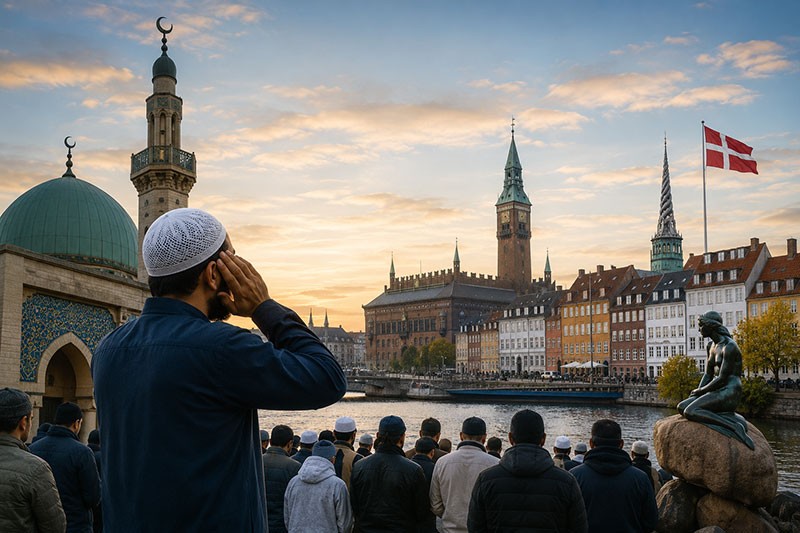
IBNS-CMEDIA: As Copenhagen considers banning the public call to prayer for the third time, the debate cuts to the heart of a continent still struggling to answer one question: how much Islam is too much Islam in modern Europe? Interestingly, this is not the far-right doing the talking, but the left-wing party led government in Denmark
The call to prayer has echoed across the world’s cities for over a thousand years. In Copenhagen, it may soon be silenced by law.
Denmark’s Immigration Minister Morten Bødskov has announced that the government is once again considering a ban on the public broadcast of the Islamic Azaan, arguing that such practices do not fit into Danish public life.
His language was blunt, even by the standards of a country that has never shied from directness on immigration. Bodskov told the Danish news agency Ritzau that “the call to prayer should not be heard over Danish rooftops” and that residents “shouldn’t be in any doubt whether you’ve ended up in a suburb of Islamabad when you walk around Denmark.”
The Islamabad reference landed like a stone in still water — rippling across Europe, sparking outrage in Muslim communities and applause in the populist right, and forcing a reckoning with questions that no government on the continent has yet managed to answer cleanly.
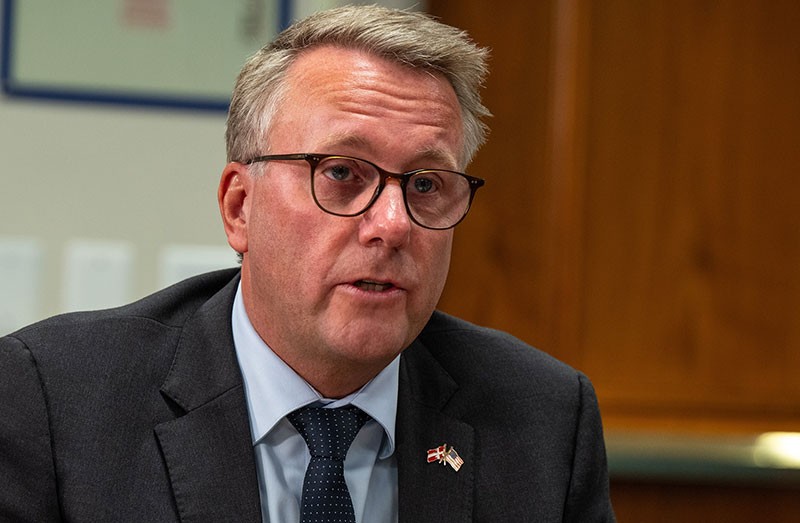 The announcement was made by Morten Bødskov, a Danish Social Democratic politician and the Minister for Integration since 2026. Photo: Wikipedia CC
The Third Attempt
This marks the third occasion that a Danish immigration minister has attempted to establish a legal basis for outlawing the public call to prayer, following earlier efforts in both 2020 and 2025. The persistence of the effort tells its own story — previous attempts stalled on legal and constitutional grounds, but the political will has not diminished. If anything, it has hardened.
Denmark has a population of around six million, including roughly 270,000 Muslims, and the country is estimated to have about 100 mosques, including the Grand Mosque of Copenhagen, which currently does not broadcast the Azaan outdoors under an agreement with local authorities.
In other words, the Azaan is not exactly thundering across Danish neighbourhoods at dawn.
The symbolic weight of the proposal, then, far exceeds its practical reach. It is less about noise and more about identity — about what a nation decides to hear, and what it decides it will not.
A Left-Wing Crackdown
What makes Denmark’s case particularly striking is that this is not the far-right doing the talking. Bodskov is a member of the Social Democrats, the left-wing party led by Prime Minister Mette Frederiksen, which is beginning its third term in government.
The proposal comes as Frederiksen begins her third consecutive term after her Social Democrats suffered their worst election result in more than a century in March, hit by voter anger over living costs, welfare pressure, and migration.
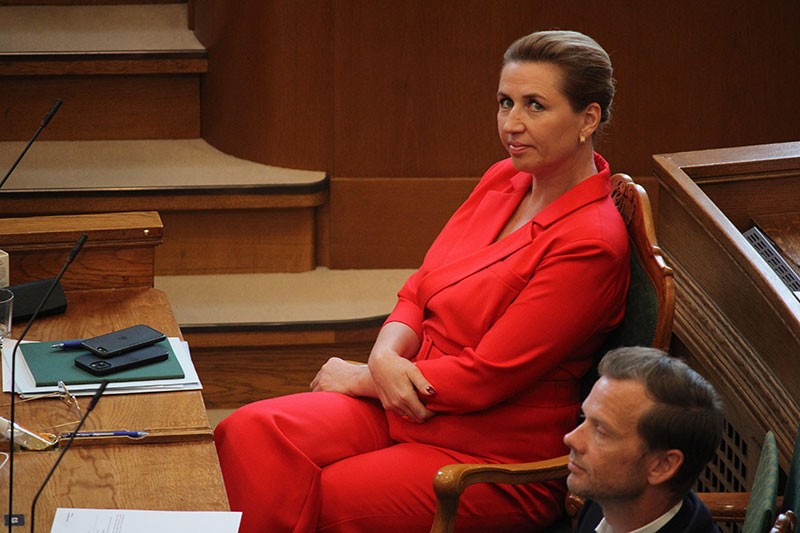 Mette Frederiksen is the prime minister of Denmark since 2019. Photo: Wikipedia CC
The right-wing Danish People’s Party, meanwhile, nearly tripled its support after campaigning for zero net migration of Muslims. Frederiksen has responded by hardening her line on Islamic visibility in public life, including calls to extend Denmark’s face-veil ban to schools and universities and remove prayer rooms from campuses.
This is the new grammar of European centre-left politics: adopt the language of the right on immigration and identity, or watch the right consume your electorate. Denmark is not alone in speaking it.
A Continent in the Same Conversation
The Danish proposal is the sharpest edge of a debate that has been reshaping European politics for two decades. Populist parties like Germany’s AfD and France’s National Rally have gained significant traction promising halts to immigration, while mainstream parties have responded with integration funds, language mandates and deradicalization centres.
Right-wing parties now hold over a quarter of seats in the European Parliament following the 2024 elections, and in late March 2026, the European Parliament voted to advance new deportation legislation shaped by conservatives and the far-right. The political wind is blowing in one direction, and it is not toward accommodation.
France bans religious symbols in public institutions under its strict doctrine of laïcité. The Netherlands has passed anti-burqa legislation. Germany’s Supreme Court has banned Muslim prayer in public schools. Denmark already operates controversial “ghetto” legislation that gives authorities the power to compel migrants to move from neighbourhoods deemed to have excessive concentrations of foreign-born residents, and asylum seekers may be required to surrender jewellery and valuables to fund their housing costs.
The Azaan ban, if it passes legal muster, would be the latest in a long line of restrictions — each incremental, each contested, each adding another layer to what Brookings scholars have called a “self-defeating” legislative approach that stigmatises entire communities while solving little.
The Integration Paradox
Here lies the contradiction at the heart of the European project. For too long, European governments masked an absence of coherent integration policy under the cloak of multiculturalism, outsourcing the hard work to foreign diplomats and Islamist institutions — a neglect that helped an unregulated underground Islam take hold in storefronts, basements and courtyards.
According to some analyst, religion is not the primary factor of identity for most European Muslims, but the current atmosphere has enhanced a feeling of group stigmatisation and a shared sense of injustice where previously few bonds existed.
“Restrict the headscarf, ban the Azaan, remove the prayer room — and you do not necessarily produce a more integrated Muslim. You may produce a more alienated one,” they feel.
Sweden’s experience offers a cautionary tale from the other direction. Since 2015, organised crime has risen dramatically, and the far-right Sweden Democrats have blamed the country’s former open-door immigration policies — with the party rising to historic heights and becoming an influential partner in the current government. Sweden’s policies have in recent years begun to mimic Denmark’s. Two Scandinavian nations, two approaches, converging on the same anxious destination.
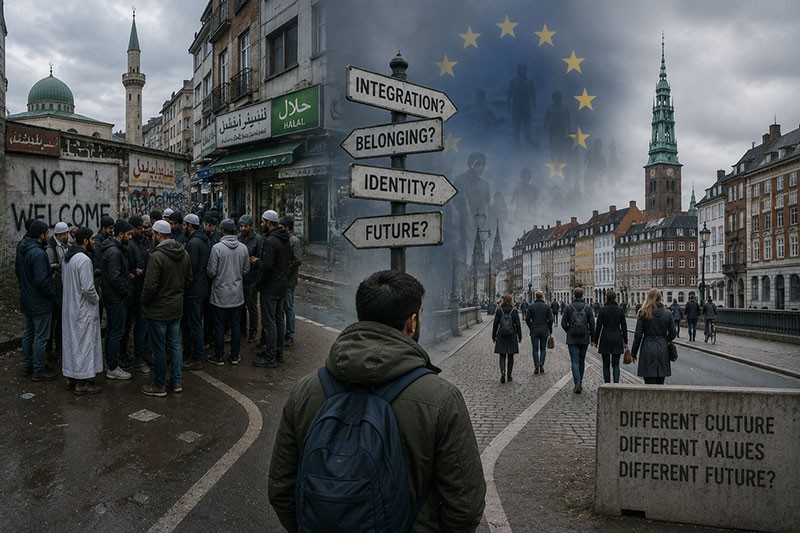 Europe’s integration challenge: balancing immigration, identity, and social cohesion in an era of growing political and cultural divides. Photo: AI generated
Douglas Murray, author of The Strange Death of Europe and one of the most prominent voices on Islam and identity in the West, has long argued that European nations have surrendered too much public space to religious expression that has no historical roots on the continent.
His position—that secular European democracies have every right to define the limits of religious visibility in shared public life—aligns squarely with the Danish proposal, even if he has not commented on it directly.
Ayaan Hirsi Ali, herself an immigrant to Europe from Somalia and one of Islam’s most prominent critics, has argued publicly that the policy of multiculturalism has failed, urging Western nations to “stop the post-national experiment.” The Somali-born Dutch-American writer would find little to dispute in Copenhagen’s logic.
The Legal Hurdle
Any attempt to ban public Azaan broadcasts nationwide could face significant legal hurdles. Denmark’s constitution protects the right to practise religion publicly, although certain restrictions already exist for activities considered anti-democratic or linked to banned organisations.
Officials are expected to examine whether a ban can be justified by balancing religious freedom with the rights of residents living near mosques.
Legal experts across Europe will be watching closely. A successful Danish ban would almost certainly embolden similar moves in other countries — and would set a precedent that religious expression can be legislated out of public space not because it causes harm, but because it unsettles a cultural majority.
The Bigger Question
Minister Bødskov’s Islamabad remark was not merely impolitic — it was revealing. The fear embedded in that comparison is not really about loudspeakers. It is about demographic anxiety, cultural continuity, and the uneasy sense in parts of Europe that the continent is becoming something its native populations did not choose and do not recognise.
That anxiety is real, and it deserves honest engagement rather than dismissal. But honest engagement also requires acknowledging that 270,000 Danish Muslims are Danish residents with Danish lives, Danish children in Danish schools, and Danish taxes contributing to the Danish exchequer.
The Azaan lasts four minutes, five times a day. The debate it has ignited will last considerably longer.