
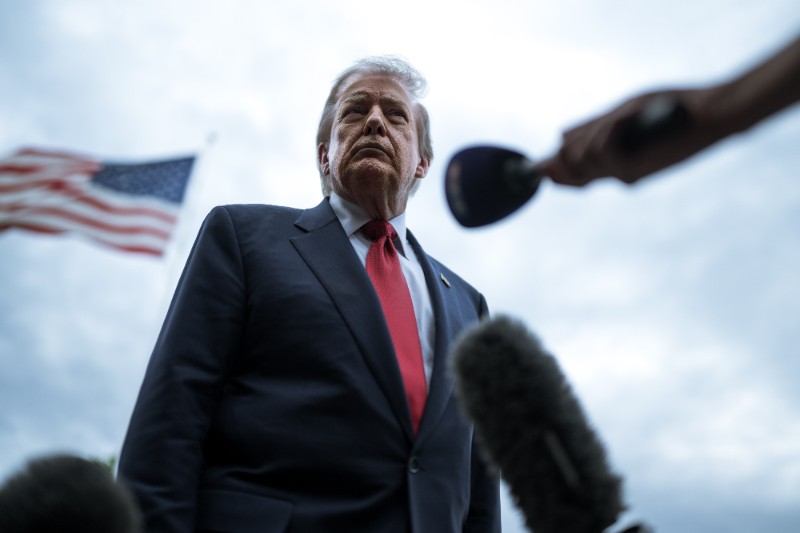
Beijing/IBNS-CMEDIA: US President Donald Trump arrived in Beijing on Wednesday for a high-stakes summit with Chinese President Xi Jinping, as both sides prepare to address growing geopolitical and economic tensions.
The two-day visit comes at a sensitive moment in US-China relations, with the widening conflict involving Iran, trade disputes, artificial intelligence competition and tensions over Taiwan expected to dominate the talks.
Trump arrives with top business leaders
Trump travelled to China with a delegation that included Elon Musk and Jensen Huang, underlining the administration’s focus on securing commercial gains and easing strains affecting trade and technology.
.@POTUS steps off Air Force One in Beijing ahead of his historic Summit this week.
He is greeted on the tarmac by Chinese Vice President Hang Zhang, @USAmbChina, and other dignitaries. pic.twitter.com/oyJXJIYVvl— Rapid Response 47 (@RapidResponse47) May 13, 2026
He was welcomed at the airport by Chinese Vice President Han Zheng, alongside US Ambassador to China David Perdue, Chinese Ambassador to the United States Xie Feng and Executive Vice Foreign Minister Ma Zhaoxu.
Chinese authorities arranged a ceremonial reception featuring a military honour guard, a military band and nearly 300 students waving Chinese flags.
.@POTUS proceeds down the red carpet in Beijing — briefly giving his signature fist pump to the assembled Military Honor Guard and Chinese youth flag wavers pic.twitter.com/aDBQdDjsx8— Rapid Response 47 (@RapidResponse47) May 13, 2026
Xi is scheduled to formally receive Trump during a state ceremony in Beijing on Thursday.
Iran conflict adds urgency to summit
The visit marks the first trip by a sitting US president to China in nearly a decade.
It also comes as Trump faces pressure at home over the economic impact of the Iran conflict and increasing political scrutiny ahead of the November midterm elections.
Before leaving Washington, Trump said the United States did not require China’s assistance in dealing with Iran.
“I don’t think we need any help with Iran. We’ll win it one way or the other, peacefully or otherwise,” he told reporters.
Trade and tech high on agenda
In addition to the Iran crisis, Trump and Xi are expected to discuss trade tensions, export controls on advanced semiconductors, artificial intelligence and market access for US companies.
Trump said he intended to urge Xi to further open China’s market to American businesses, especially technology firms.
In a post on Truth Social, Trump described Xi as “a Leader of extraordinary distinction” and said he would press for greater opportunities for US companies operating in China.
Beijing reiterates four ‘red lines’
Ahead of Trump’s arrival, China’s embassy in Washington said Beijing had identified four issues that must not be challenged in bilateral relations.
These are the Taiwan question, democracy and human rights, political systems, and China’s development rights.
The four red lines in #China–#US relations must not be challenged. #ChinaUSRelations #ChinaDiplomacy pic.twitter.com/4kmNeEWLGH— Chinese Embassy in US (@ChineseEmbinUS) May 12, 2026
The embassy said China and the United States should work towards a strategic, constructive and stable relationship based on mutual respect, peaceful coexistence and win-win cooperation.
Xi first outlined the four “red lines” during his meeting with then-US President Joe Biden in November 2024.
Taiwan expected to be major flashpoint
Taiwan is expected to be one of the most sensitive issues during the summit.
China regards Taiwan as part of its territory and has repeatedly opposed US arms sales to Taipei.
On Wednesday, China’s Taiwan Affairs Office reiterated its opposition to military ties between Washington and Taiwan.
Spokesperson Zhang Han said Taiwan represented the “core of China’s core interests” and called on the United States to honour commitments under the One China policy.
Although Washington does not formally recognise Taiwan as a sovereign state, US law requires the government to provide Taipei with the means to defend itself.
In December, the Trump administration announced an $11 billion arms package for Taiwan, the largest such package to date.
Rare earths and tariffs under discussion
The summit is also expected to cover China’s export controls on rare earth minerals and efforts by both countries to manage long-running trade disputes.
Trump’s ambitions for the visit have been narrowed by recent court rulings affecting tariff measures, with the administration focusing on possible deals involving agricultural exports, beef and aircraft sales, including orders for planes made by Boeing.