
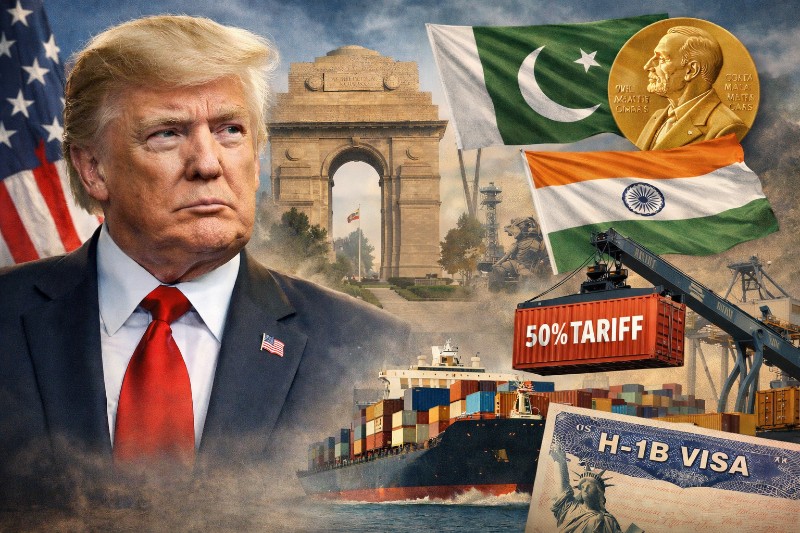
IBNS-CMEDIA: In the months following his inauguration for a second term, US President Donald Trump’s approach to India has marked a dramatic departure from the groundwork of the earlier strategic partnership.
Once anchored in defence cooperation and mutual geopolitical interests, the relationship has been buffeted by diplomatic missteps, economic confrontations and controversies over presidential rhetoric.
Analysts say these developments underscore widening policy gaps between Washington and New Delhi.
A ‘friendship’ under strain
Donald Trump’s much-publicised personal rapport with Prime Minister Narendra Modi has shown visible signs of erosion during the US president’s second term, amid trade disputes, diplomatic snubs and public disagreements.
Very recently, praising Modi as “a good man“, Trump claimed that the Indian PM had acted to make him “happy”.
“Basically, Modi is a very good man. He knew I was not happy, and it was important to make me happy,” Trump said.
The strain in the India-US relationship surfaced prominently after US Commerce Secretary Howard Lutnick claimed a bilateral trade deal stalled because Modi did not personally call Trump.
New Delhi firmly rejected the assertion, saying negotiations had involved multiple rounds and both leaders had spoken eight times last year.
India described Lutnick’s version of events as “not accurate,” underscoring that talks had come close to completion several times.
Reports have also indicated that Trump attempted to speak with Modi on at least four occasions without success.
A German newspaper suggested this reflected growing mistrust, citing Trump’s history of prematurely announcing deals without partner consent.
Analysts noted Modi’s caution followed Trump’s unilateral trade declarations with other world leaders.
Despite occasional phone calls, including on Modi’s birthday, recent developments suggest a cooling of what was once portrayed as a close personal partnership.
Pahalgam attack: Divergent narratives and diplomatic friction
Just four months into his second term, the deadly terror attack in Jammu and Kashmir’s Pahalgam and the Indian armed forces’ counter-terror strike, Operation Sindoor, targeting terrorist bases in Pakistan and Pakistan-occupied Kashmir (PoK), became an unexpected flashpoint in US-India relations.
While the Trump administration publicly condemned the hostilities, India’s official position maintained that there was no third-party intervention in securing the subsequent ceasefire with Pakistan.
Despite this, President Trump repeatedly claimed credit for defusing the conflict, asserting that his pressure — including tariff threats — halted escalation between the two nuclear-armed neighbours.
New Delhi firmly rejected these assertions, emphasising that direct military-to-military dialogue achieved cessation of hostilities.
Glorifying Pakistan? A diplomatic miscalculation
In the aftermath of the Pahalgam clashes and India’s Operation Sindoor, the Trump administration’s vocal overtures to Islamabad — including public praise and acceptance of Pakistan’s official nomination of Trump for the Nobel Peace Prize — have further unsettled bilateral ties.
Trump’s remarks about ending conflicts through tariffs and his promotion of Pakistan’s praise contrasted sharply with India’s firm rejection of US mediation, creating unease in New Delhi.
The US President’s repeated linking of his peace claims to Nobel recognition, including remarks that a lack of the prize would be an “insult” to the United States, has drawn attention internationally.
Though he downplayed his own interest at times, his assertions of resolving global conflicts — including the India-Pakistan standoff — have been met with scepticism and rebuttal by Indian officials.
Trade warfare: 50% tariff shock
Compounding diplomatic strains, the Trump administration delivered a significant economic blow to India by imposing steep tariffs on Indian imports.
Originally levied as duties tied to complaints over energy ties with Russia, the duties were sharply increased to a 50 percent tariff — one of the highest levies on a major US trading partner.
Washington framed the escalation as targeting India’s trade and energy policies, but the move has been widely criticised in New Delhi and within US political circles as punitive and counterproductive to longstanding cooperation.
Indian-American voices in the US have decried the tariff escalation, highlighting its potential to unravel decades of partnership and harm economic ties.
Some prominent lawmakers emphasised that treating India with harsher trade penalties than China signals a deeper rift in US strategic thinking.
H-1B reforms: A visa blow to Indian professionals
Beyond trade, significant changes to the United States’ H-1B visa regime have also disproportionately affected Indian nationals.
The Trump administration introduced major fee increases and policy reforms to the H-1B system, including a new fee structure that critics argue will disadvantage Indian applicants, who constitute a large share of the visa category.
While not exclusively targeted at Indians, these changes have reverberated across India’s professional diaspora, feeding perceptions of discrimination and complicating a pillar of bilateral people-to-people ties.
Trump 2.0: A relationship tested
Together, these developments reflect an era of US-India engagement defined by friction rather than alliance consolidation.
From divergent narratives over the India-Pakistan conflict and contrasting acknowledgements of diplomatic roles, to punitive economic measures and sweeping visa reforms, the Trump administration’s actions have tested the resilience of one of Washington’s key strategic partnerships.
In New Delhi, policymakers continue to navigate these headwinds while reaffirming India’s strategic autonomy and long-term national interests amid shifting global geopolitics.
(Reporting by Deepayan Sinha)