
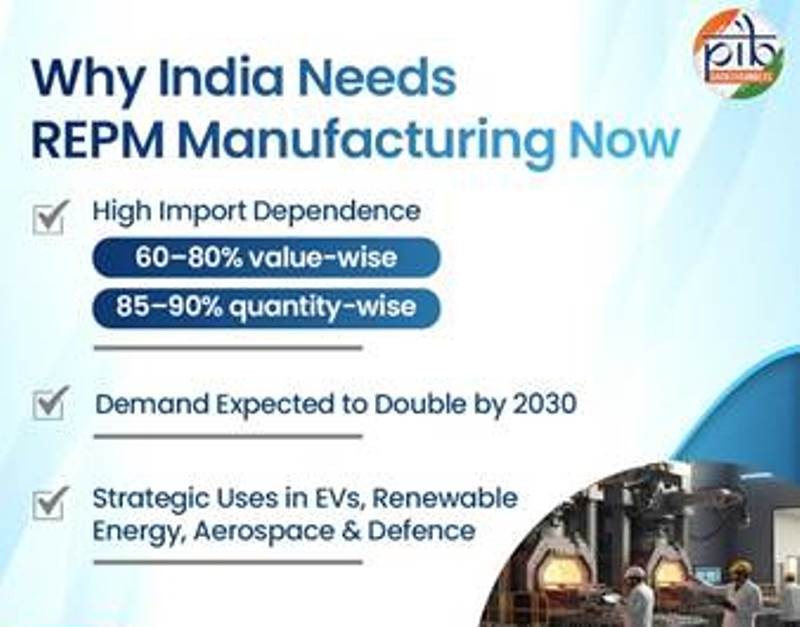
IBNS-CMEDIA: The Indian government has approved the Scheme to Promote Manufacturing of Sintered Rare Earth Permanent Magnets (REPM) with a total financial outlay of Rs. 7,280 crore.
The scheme seeks to establish 6,000 metric tonnes per annum (MTPA) of integrated REPM manufacturing capacity within the country, spanning the entire value chain—from rare-earth oxides to finished permanent magnets.
By creating a robust, domestic, end-to-end manufacturing ecosystem, the initiative aims to significantly enhance India’s self-reliance in a critical input for key sectors such as electric vehicles, renewable energy, electronics, aerospace, and defence. The programme is also designed to position India as a competitive global player in the rare earth permanent magnet market, while strengthening supply-chain resilience in strategically important industries.
The scheme aligns closely with national priorities, including Atmanirbhar Bharat, the development of secure and resilient supply chains, and India’s long-term Net Zero emissions target by 2070.
What are Rare Earth Permanent Magnets (REPMs)?
Rare Earth Permanent Magnets are among the strongest and most efficient permanent magnets available today. Their exceptional magnetic strength, stability, and compact size make them indispensable in advanced technologies that demand high performance in limited space.
REPMs are widely used in:
Electric vehicle motors
Wind turbine generators
Consumer and industrial electronics
Aerospace and defence systems
Precision sensors and actuators
The ability of REPMs to deliver powerful magnetic performance in compact form factors is critical for modern engineering applications. As India accelerates manufacturing across priority sectors such as clean energy, advanced mobility, and defence, developing a reliable domestic supply of high-performance magnets will be essential for ensuring long-term competitiveness, technological leadership, and supply-chain security.