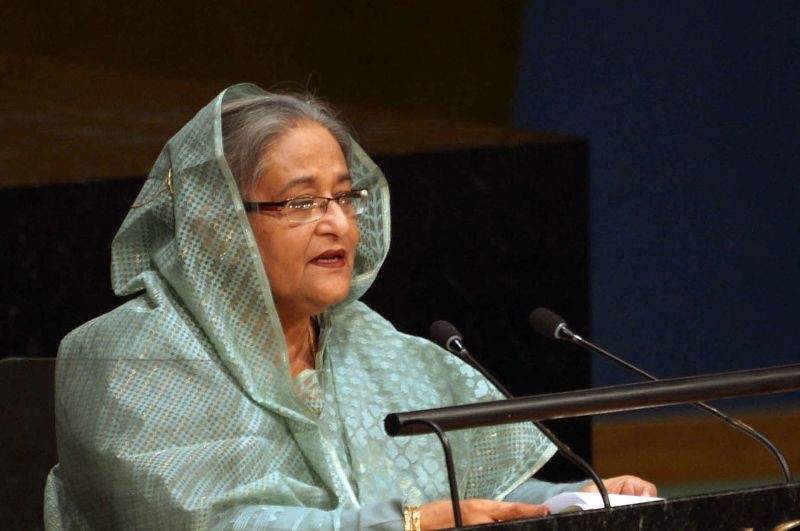
IBNS-CMEDIA: Ousted former Bangladesh Prime Minister Sheikh Hasina has expressed her intention to return to Bangladesh from exile in India on December 16, coinciding with the country’s Victory Day celebrations.
Hasina fled to India on August 5, 2024, following massive student-led protests against her government, bringing an end to her 15-year rule.
In a statement, her spokesperson, Syed Mozammel Ali, was quoted by the Associated Press as saying: “Since Sheikh Hasina was flown to India on a Bangladesh aircraft on August 5th, 2024, she now calls upon the government to arrange for her air transport from Delhi back to Dhaka.”
December 16 is celebrated as Victory Day in Bangladesh, commemorating the country’s victory over Pakistan in the 1971 Liberation War and its emergence as an independent nation.
This is the first time Hasina, who has been sentenced to death by a Bangladeshi tribunal for crimes against humanity over her government’s crackdown on the 2024 July Uprising, has specified a date for her proposed return.
Bangladesh has witnessed mounting political tensions in recent days, with the Awami League banned months after Hasina’s departure.
Bangladesh garment industry suffers $428 million in production losses
Meanwhile, Bangladesh’s crucial ready-made garment (RMG) industry has suffered production losses worth $428 million during 18 days of unrest in November. International buyers have also shifted confirmed orders worth another $254 million to competing countries, according to a preliminary industry survey.
The findings, released by the Bangladesh Garment Manufacturers and Exporters Association (BGMEA), have raised concerns over the impact of continuing political instability on Bangladesh’s position as the world’s second-largest apparel exporter after China.
Industry representatives described the figures as “worrying”, particularly as Bangladesh faces growing competition from major garment-producing countries, including Vietnam, Türkiye, India and Italy.
The economic disruption comes amid recent political violence, protests and shutdowns by garment workers demanding higher wages since October.
Prime Minister Tarique Rahman has also proposed dialogue with what he described as “anti-fascist political parties” in an apparent attempt to address the prevailing political tensions.
Over 300 factories report production losses
The BGMEA said its preliminary survey covered the period from November 1 to 18 and collected responses from 317 garment factories.
The participating factories reported production disruptions linked to the prevailing instability and various operational challenges.
According to the industry body, the affected factories incurred production losses amounting to $428 million in free-on-board (FOB) value over the 18-day period.
The findings underline the scale of the disruption in an industry that remains central to Bangladesh’s export earnings, employment and manufacturing economy.