IBNS-CMEDIA: Democratic Congresswoman Haley Stevens has switched sides in one of Michigan’s most closely watched Senate contests, endorsing Republican Mike Rogers over her party’s nominee, Abdul El-Sayed, just days before voters head to the polls.
Her dramatic decision followed weeks of escalating tensions over Israel and the war in Gaza, turning an already bitter Democratic primary rivalry into a public party dispute.
Stevens, who lost the Democratic Senate primary to El-Sayed in August, had previously promised to support him.
As recently as Wednesday, she had said she wanted him to win.
However, on Sunday, she announced her backing for Rogers, arguing that El-Sayed’s campaign had crossed a line over its rhetoric on Israel.
The endorsement has angered senior Democrats, prompted resignations within Stevens’s congressional team and drawn praise from President Donald Trump and Republican leaders.
Israel dispute behind Stevens’ U-turn
Haley Stevens is a strong supporter of Israel, while El-Sayed has been a vocal critic of Israel’s military campaign in Gaza and US military assistance to the country.
Their differences over the issue featured prominently during the Democratic primary, when a super PAC affiliated with the American Israel Public Affairs Committee (AIPAC) spent tens of millions of dollars supporting Stevens.
The latest confrontation followed an advertisement released last week by Rebellion PAC, an independent group backing El-Sayed.
ANTISEMITISM: THE NAZI PLAYBOOK IN MODERN POLITICAL CLOTHING This is an utterly depraved, morally obscene resurrection of antisemitic propaganda, repackaged for American political consumption. Under the fluorescent lights of a grocery store, this grotesque advertisement resurrects the same poisonous architecture of scapegoating that Nazi propagandists weaponized to indoctrinate an entire nation: exploit economic suffering, manufacture resentment, portray Jewish interests as sinister financial manipulators, and convince ordinary citizens that their hardships are the fault of the Jewish people and their supposed stranglehold on government. The imagery has changed. The venom has not. By insinuating that Israel is responsible for Americans struggling to afford groceries and healthcare, then displaying Benjamin Netanyahu alongside allegations of pro-Israel interests purchasing Senate seats, Cenk Uygur’s Rebellion PAC has produced a spectacle that invokes some of history’s most malignant antisemitic tropes. Debating American foreign aid is legitimate political discourse. Exploiting economic desperation through imagery and insinuations reminiscent of the propaganda that helped prepare the ground for the Holocaust is something far more sinister. History has already demonstrated where the systematic poisoning of public conscience through antisemitic scapegoating can lead. Six million Jews paid for that lesson with their lives. I call upon EVERY major media organization, elected official, political leader, and candidate, regardless of party affiliation, to condemn this advertisement unequivocally and demand that X remove it immediately. Political advertising cannot become a sanctuary for the rehabilitation of antisemitic propaganda. Nor can freedom of expression become an excuse for moral cowardice in confronting it. Antisemitism does not become less poisonous because it is wrapped in campaign messaging. And the silence of those entrusted with public leadership only grants that poison a wider audience. The world has witnessed the catastrophic consequences of this hatred before. We must never allow its oldest lies to become tomorrow’s accepted truths.
— Isaac Halevi 🎙️🌐 (@Isaac_Halevi) October 26, 2026
The advertisement linked US military aid to Israel with the rising cost of living in America.
It showed a couple shopping for groceries who put back a carton of eggs, saying they needed to save the money for “killing Palestinians”.
Stevens described the advertisement as anti-Semitic and demanded that El-Sayed condemn it.
She also accused him of making similar arguments by suggesting that money spent on Israel could instead fund schools, healthcare and childcare.
El-Sayed responded that his campaign had not produced the advertisement and that he disagreed with its message.
He accused Stevens of trying to reopen their primary contest instead of concentrating on defeating Rogers.
The disagreement intensified on Sunday, when Stevens and El-Sayed were expected to attend a church service together as a show of Democratic unity.
However, Stevens was told not to attend.
“Our Democratic nominee for Senate said I was no longer welcome in his campaign and that I should stay away,” Stevens said in a video posted on X.
I am endorsing Mike Rogers for the United States Senate today. https://t.co/pQgfSBuhOJ
— Haley Stevens (@HaleyforMI) November 1, 2026
“And he’s right. And that’s why I am endorsing Mike Rogers for the United States Senate today,” she added.
Congresswoman Debbie Dingell, who helped organise the event, later told The Associated Press that she had asked Stevens not to attend because the dispute had become “way too distracting”.
Appearing on CNN, Stevens said El-Sayed was becoming “angrier and angrier” and accused him of engaging in “some” anti-Semitic actions during the campaign. She insisted that her decision was intended to help the Democratic Party.
here’s the entirety of the seeming mental breakdown Haley Stevens just had on CNN. One of the most bizarre and incoherent political interviews I can recall. Note how she’s completely unable to explain why she changed her mind from supporting Abdul El-Sayed last night to endorsing Mike Rogers today.
— Aaron Rupar (@atrupar) November 2, 2026
Stevens also criticised El-Sayed’s association with political streamer Hasan Piker.
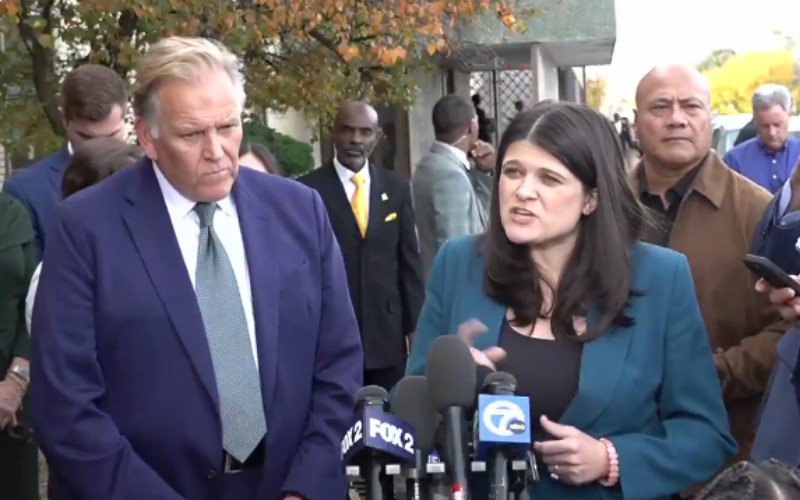
Standing alongside Rogers, she told reporters: “We can’t stand with hate. We can’t stand with Hasan Piker.”
She maintained that she remained a Democrat and would vote for Democratic candidates in 90 percent of the races on her ballot, but would support Rogers in the Senate contest.
Democrats condemn Stevens’ endorsement
The endorsement triggered a sharp response from Democratic leaders. Senate Democratic Leader Chuck Schumer, who had encouraged Stevens to contest the open Senate seat, described her decision as a “despicable betrayal”.
Schumer said Senate Democrats remained united behind El-Sayed and urged voters to focus on healthcare, civil rights and the differences between the Democratic nominee and Rogers, who has Trump’s backing.
Abdul El-Sayed is deeply panicked and deeply concerned that Haley Stevens just dropped a nuke on his campaign. “At the end of the day, I actually don’t think about Haley Stevens” He won’t recover from this. It’s over. https://t.co/FxEPpZ2bJf
— Benny Johnson (@bennyjohnson) November 1, 2026
The Democratic National Committee also criticised Stevens.
Chair Ken Martin described her endorsement of Rogers as a betrayal of party values and accused her of creating divisions at a crucial moment in the campaign.
Michigan Democratic Party Chair Curtis Hertel similarly said Stevens had abandoned the principles she claimed to support.
The fallout also reached Stevens’s congressional office. Justin German, her chief of staff for eight years, announced that he and several other members of her team had resigned over the endorsement.
“We are shocked and heartbroken by Congresswoman Stevens’s decision to support Mike Rogers,” German said in a statement shared with CNN.
Stevens did not directly confirm the resignations during her CNN interview, saying instead that her office was “in a transition” as she prepares to leave Congress in January.
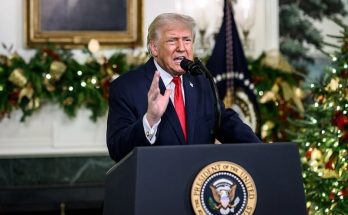
Trump welcomed her decision, writing on social media: “Wow, this is BIG!” At a rally in Iowa, he praised Stevens and said he would “love” to see her join the Republican Party.
 US President Donald Trump’s Truth Social post
House Speaker Mike Johnson also congratulated her, describing the endorsement as “courageous”.
Could the switch affect Michigan’s Senate race?
El-Sayed and Rogers are competing to replace retiring Democratic Senator Gary Peters.
The result could influence control of the US Senate, where Democrats are seeking to challenge Trump’s agenda and increase scrutiny of his administration.
Stevens had defeated El-Sayed in Wayne County, which includes Detroit, and neighbouring Oakland County during the Democratic primary.
Both are Democratic strongholds, and the extent to which her endorsement influences voters in those areas could prove significant.
However, Reuters polling cited in the report suggests El-Sayed has largely consolidated Democratic support.
Early voting began on October 24, before the latest dispute erupted.
Stevens could face party disciplinary action
Stevens’ endorsement could also have consequences within the House Democratic Caucus.
Its rules state that members seeking to maintain membership must not participate in campaign activities for a candidate in a partisan federal election who is not a Democrat.
Several organisations representing Jewish, Muslim and Democratic voters, including IfNotNow, MPower Action and Our Revolution, have urged House Minority Leader Hakeem Jeffries to expel Stevens from the caucus and remove her committee assignments.
Congresswoman Pramila Jayapal has also expressed support for removing Stevens from the Democratic Caucus, according to POLITICO.
Stevens has only two months remaining in office after her Senate bid prevented her from seeking re-election to her House seat.
Any disciplinary action could therefore have a limited period in which to take effect.
Republicans currently hold a narrow 218-214 majority in the House.
Removing Stevens from the Democratic Caucus could further complicate the party’s position during the remaining weeks of the current Congress.
Michigan Democratic Party chair Hertel said on social media that Stevens “is not a current member of the Michigan Democratic Party, nor will she be in the future”.