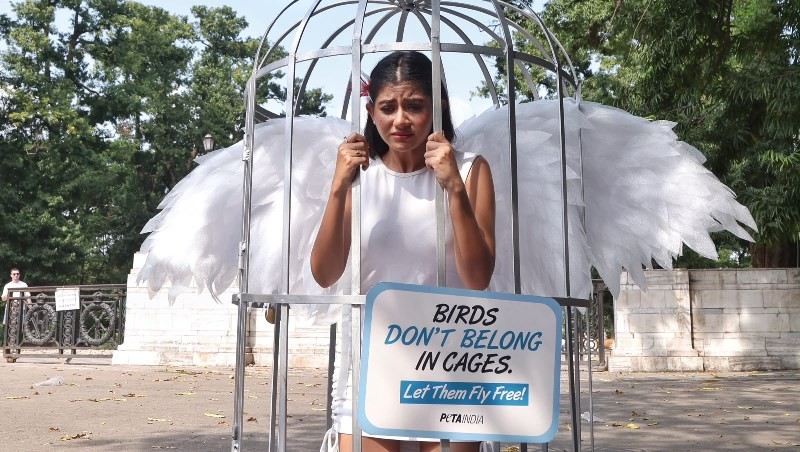
Kolkata/IBNS-CMEDIA: Actor and People for the Ethical Treatment of Animals (PETA) India supporter Prantika Das staged a protest outside Victoria Memorial on Tuesday against the illegal trade and captivity of birds, following a Calcutta High Court directive extending restrictions on unauthorized animal trade across West Bengal.
Dressed in white with giant wings and confined inside a cage, Das drew public attention to the suffering of birds kept in captivity. A sign beside her read, “Birds Don’t Belong in Cages. Let Them Fly Free.”
Actress Prantika Das said, “Birds are meant to feel the wind in their wings, not languish in cages. PETA India and I are calling on Kolkata residents to buy a pair of binoculars and watch beautiful birds in their natural habitats instead of imprisoning them.”
The Calcutta High Court issued landmark directions concerning the freedom of birds on March 26, 2021, prohibiting their hunting, buying, selling and exchange in West Bengal. On October 14, 2026, the court reviewed the order and extended its strict anti-illegal pet trade directives across the state, expanding their scope beyond Kolkata’s Galiff Street market.
Welcoming the court’s directions, Das called for stronger measures to protect animals. She urged people to stop buying and selling birds, stressing that flying freely is a natural part of their lives.

“I just enacted being a bird, I can imagine what kind of suffering they may go through while I was there in the cage. I felt so claustrophobic, it was suffocating me inside out and there was nobody to speak to. So, I would encourage everybody to stop buying and selling birds, because their basic rights are to fly free. I think as humans we got no right to cage them inside,” Das added.
Speaking about the experience, Das said she found it painful to remain inside the cage, even for a short period, in the scorching heat and humidity. She said the experience helped her imagine the distress birds endure when confined and deprived of their freedom.
The campaign highlighted the physical and psychological impact of captivity on birds. In the wild, birds engage in natural activities such as building nests, socialising and raising their young. When confined to cages, they may experience stress, isolation and behavioural problems, including excessive preening and feather-plucking. Birds caught for trade can also suffer injuries, dehydration, starvation and severe stress during transportation.
Das further added, “It breaks my heart to even address something like this. I feel very bad that we have been doing this for so many years of selling and buying these species. All thanks to Calcutta High Court for issuing this directory against the illegal purchase and unauthorized breeding. I feel that these kinds of laws, these kinds of directories should be introduced more often in case they protect all the animals, especially the birds.”
The Wildlife (Protection) Act, 1972, prohibits the capture and trade of protected indigenous wild birds, while international trade in endangered species is regulated under the Convention on International Trade in Endangered Species of Wild Fauna and Flora (CITES). The legal framework also provides for action against violations involving protected wildlife.

PETA India campaigns for animal protection and opposes the use of animals for human exploitation. Through the protest, Das and the organisation urged Kolkata residents to reject the bird trade and allow birds to live freely in their natural surroundings.
(Reporting by Aaheli Chakraborty, Photos by Avishek Mitra/IBNS)