
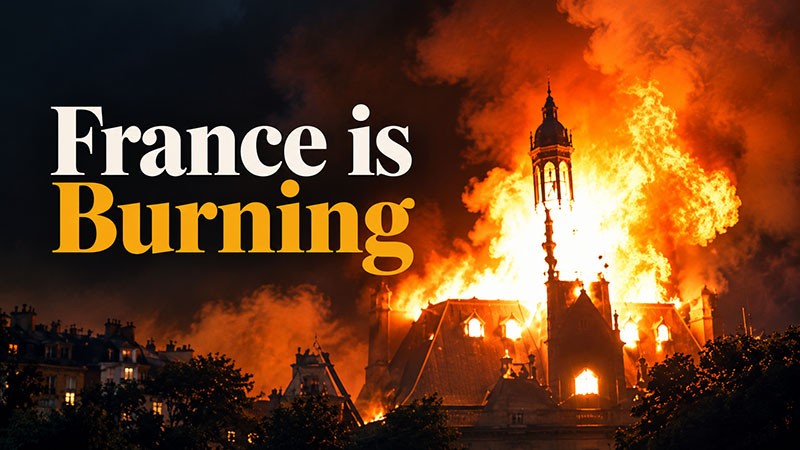
IBNS-CMEDIA: It started with a fair complaint: Let’s be straight about the beginning. Since September 18, French high-school students have been protesting leaking classrooms, teacher shortages and the rising cost of living. These are real problems, and the state has been slow to fix them. When a teenager lost a hand in Saint-Étienne during the protests, that was a real failure of policing too. Anyone who dismisses the whole movement as a mob is not telling the truth.
But what happened on Saturday was not a protest. About 550,000 people marched peacefully in 110 cities. Then masked groups took over.
In Limoges they burned a police car, broke into the town hall, and set it on fire. The prefect said the roof had collapsed and two-thirds of the exterior was gone. It was a 143-year-old landmark. Shops nearby were looted. More than 1,800 people were arrested across the country.
Nobody burns a town hall to get better school funding. That is arson, and it has nothing to do with education
The far left’s role
France’s government says it knows who is behind it. At a crisis meeting on October 1, intelligence services reported that the movement was started by hard-left politicians, describing it as an operation organised by La France Insoumise (LFI) and its allies on the far left.
The prime minister later told Parliament that the movement had been hijacked by the far left and by people who want to throw the country into chaos before next year’s election.
LFI denies it and says it supports only peaceful protest. That denial deserves a hearing, and courts and investigations will test it. But the pattern is hard to ignore. La France Insoumise (LFI) founder Mélenchon’s party has spent years treating the police as the enemy and street confrontation as a political tool. When you tell angry teenagers the state is an oppressor, you should not be surprised when some of them treat its buildings as targets.
The victims are not the rich or the powerful. Sixty-five school staff have been injured, including 40 headteachers. About 400 high schools were shut at one point. Police and gendarmes have been hurt in large numbers. These are the people who keep the system running
Then there is the question that polite commentary avoids. The worst unrest has centred on Seine-Saint-Denis, in towns like Saint-Denis, Aubervilliers and Pantin. These suburbs have started national unrest before, in 2005 and again in 2023. Be careful here, because the facts are limited.
Nearly 6,900 people were taken into custody in the first two weeks, and 86% were minors. No official figure ties the violence to origin or religion, and France does not collect ethnic data. Some analysts argue that far-left, Islamist and pro-Palestinian networks are exploiting the chaos. That is a serious charge and it needs evidence.
But pretending the geography means nothing is its own kind of denial. After decades of policy and billions in spending, too many young people in these neighbourhoods feel no loyalty to the Republic. Integration has failed, not for everyone, but badly enough that radicals of every stripe find an audience. A country that will not discuss this openly will keep being surprised by it.
Macron’s failure, Le Pen’s gain
Macron is a lame duck. His centre has collapsed, his government is unpopular, and his answer to the violence has been condemnation with no plan behind it. His recognition of Palestine was attacked by CRIF, the body representing French Jews, as a moral and diplomatic mistake. Whatever you think of the policy, it did nothing to calm his own streets. The Palestinian flag is now turning up in street clashes next door in Brussels.
Jamais nous ne devons confondre nos compatriotes qui ont manifesté avec la volonté de porter des revendications légitimes, avec ceux qui ont détruit, pillé, cassé. https://t.co/3mhsCzCNOb
— Emmanuel Macron (@EmmanuelMacron) October 18, 2026
The winner is obvious. Marine Le Pen, the leader of the far-right National Rally, is the clear frontrunner in next year’s presidential race.
A mid-October Odoxa poll put her at 37 to 38% in the first round, well ahead of every rival, with the vote set for 18 April 2027. She enters the campaign carrying a 2025 embezzlement conviction over the use of EU funds, though reports say she remains eligible to stand. Her line on the unrest has been consistent: the grievances are real, but the violence is not.
“Violence is not an opinion,” she said in a video address after the weekend’s riots. She also told voters that France’s leadership had lost its authority, a charge aimed squarely at Macron.
Every burning barricade works for her, and the centre has no order to show in reply.
Vous avez vu hier nos villes, nos rues, notre pays, malmenés, maltraités, mis à sac. Nous vivons une crise profonde de confiance, d’autorité qui fait peser une menace sur la démocratie. Le constat doit nous alerter : notre pays est pris en étau, voire en otage, entre la violence et l’impuissance.
— Marine Le Pen (@MLP_officiel) October 18, 2026
On the other hand, Jean-Luc Mélenchon, founder of the hard-left La France Insoumise (LFI), is preparing his fourth run for the presidency after campaigns in 2012, 2017 and 2022. He came within a few hundred thousand votes of the run-off in the last two, and polls now put him second behind Le Pen at around 18%, though she beats him easily in a head-to-head.
His party backed the student movement, and he marched in Paris on Saturday, saying most demonstrations were peaceful. LFI denies orchestrating any violence. But French intelligence, the interior minister and the prime minister have all pointed at the far left, and Le Pen has gone further, accusing his deputies of “viewing order as oppression and disorder as a right.”
Debate over immigration, integration, identity
As France confronts fresh street violence, political scientist Gilles Kepel’s analysis of the country’s deepening identity fractures offers a compelling lens.
The torching of public buildings and attacks on symbols of the Republic demand a firm response: social grievances cannot become an excuse for lawlessness or the erosion of France’s secular civic values.
Conservative commentator Douglas Murray has long argued that Europe has been reluctant to confront the consequences of mass immigration and failures of integration. In The Strange Death of Europe: Immigration, Identity, Islam (2017), he writes: “For even if you believe — as most people do — that some immigration is a good thing and makes a country a more interesting place, it does not follow that the more immigration the better.”
The immediate unrest has been linked by authorities to far-left groups and criminal elements; any wider role for Islamism must be established through evidence, not assumption. But questions of identity, integration and extremism cannot be beyond debate.
Spread to Belgium and Italy
The unrest has crossed borders, but unevenly. In Belgium, police clashed with demonstrators in Liège on 7 October. In Brussels, about 30,000 people joined an anti-austerity march, while separate masked groups fought police and set fires.
In Italy, students occupied schools in Turin and Rome under the slogan “Let’s do as in France,” but there was no arson on the French scale.
Observers say these are separate movements, not one coordinated campaign. France and Belgium both run deficits above 5% of GDP, so neither has much to spend on school
Yet the questions this unrest raises are not French alone. Across Europe, governments struggle with the same set of problems: how to integrate second- and third-generation communities, how to handle illegal and legal migration, and how to stop radical networks, whether far-left or Islamist, from recruiting angry young people.
French authorities have not blamed immigrants for this wave, but the debate it has reopened is real. American politicians have linked the riots to mass immigration, Hungary’s opposition leader Péter Magyar has used them to defend his country’s strict border policy, and one analyst argues that far-left, Islamist and pro-Palestinian movements are converging to exploit the chaos.
Whether any of that proves true can only be settled by evidence. What is already clear is that Europe’s governments have put off these conversations for years, and next year’s elections will not let them wait any longer.


