
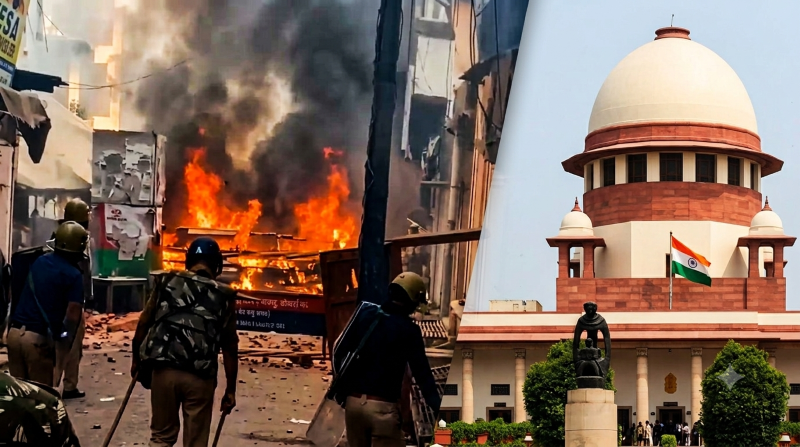
New Delhi/IBNS-CMEDIA: The Supreme Court on Tuesday quashed the preventive detention of Mulla Afroz, an accused in the Sambhal violence case, under the stringent National Security Act (NSA), holding that his detention could not be based solely on a confession allegedly made while he was in police custody.
A bench comprising Justices Dipankar Datta and Sheel Nagu also imposed costs of Rs. 10 lakh on the Uttar Pradesh government over the detention order.
Supreme Court questions basis of detention
The court held that a confession allegedly made by an accused while in police custody could not, by itself, form the basis for preventive detention under the NSA.
The ruling came after the Uttar Pradesh government invoked the NSA against Afroz in connection with his alleged role in the November 2024 Sambhal violence.
Afroz was detained under the NSA shortly after being granted bail in a violence-related case.
The Supreme Court also set aside the Allahabad High Court judgment that had upheld the detention order.
What happened in Sambhal
The violence broke out in Sambhal, Uttar Pradesh, on November 24, 2024, during a court-ordered survey of the Shahi Jama Masjid.
The survey followed a petition claiming that the mosque had been built at the site of a Hindu temple. Protests erupted around the mosque as the survey team arrived, leading to clashes that resulted in deaths and injuries.
Several criminal cases were subsequently registered in connection with the violence.
Mosque survey dispute remains before court
The underlying dispute over the Shahi Jama Masjid remains pending before the courts.
On September 25, 2026, the Supreme Court reserved its verdict on a plea filed by the Shahi Jama Masjid Committee challenging the trial court’s order appointing an Advocate Commissioner to survey the mosque premises.
The original petition claimed that the mosque stood at the site of a demolished Hindu temple.