
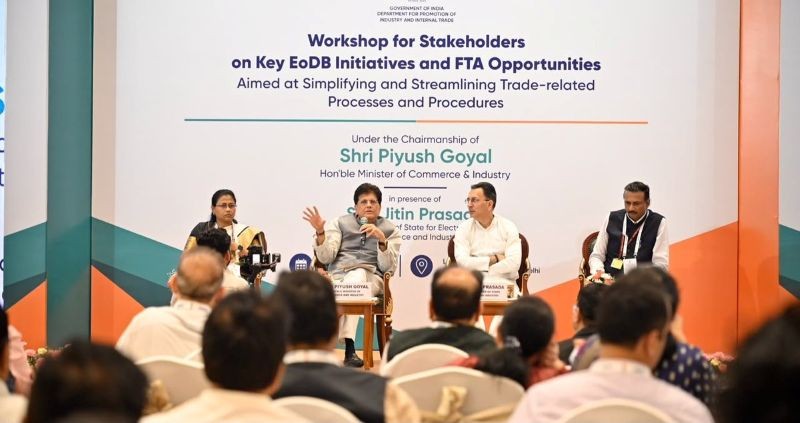
IBNS-CMEDIA: The Indian governemnt’s Department for Promotion of Industry and Internal Trade (DPIIT) on Tuesday organised a stakeholder workshop on Ease of Doing Business (EoDB), Free Trade Agreement (FTA) opportunities and ongoing trade-related reforms at Bharat Mandapam in New Delhi.
The workshop was followed by an interactive session with Union Commerce and Industry Minister Piyush Goyal and Minister of State for Commerce and Industry Jitin Prasada.
During the interaction, Goyal outlined the government’s approach to strengthening export facilitation through physical and digital mechanisms.
He said that instead of establishing separate offices of individual departments at different locations, integrated Commerce and Industry offices were being envisaged in major cities to provide businesses with a common point of access to multiple departments and agencies.
Goyal also held an interaction with industry representatives and directed officials to examine several suggestions raised by participants. The meeting was the first such interaction with a regional industry association.
Representatives from the roller chain and industrial components manufacturing sector highlighted the positive impact of recent policy measures on domestic manufacturing.
The industry said measures such as Quality Control Orders (QCOs), Minimum Import Price (MIP) provisions and higher import duties had contributed to significant growth in the sector, including a 15-fold expansion, fresh investments of around Rs 500 crore and the creation of approximately 5,000 jobs.
The industry representatives welcomed the measures, saying they had helped strengthen domestic manufacturing capacity, encourage investment and create employment opportunities.
Goyal also announced a proposed network of around 1,000 trained local personnel with knowledge of regional languages to support exporters and prospective exporters at the district and state levels.
The personnel would be trained and deployed to provide handholding support to businesses through industry chambers and regional associations.
Goyal also briefed participants about the proposed Trade Connect platform, which is being developed to provide exporters with product-wise and HSN-code-wise information, including destination-country tariffs, FTA opportunities and procedures for availing FTA benefits.
The platform is also expected to use digital and AI-enabled tools to help businesses identify potential export opportunities and infrastructure gaps.
The workshop brought together representatives of industry associations, trade bodies and sectoral organisations, along with senior officials from DPIIT and the Department of Commerce.
Discussions focused on ongoing EoDB reforms, trade facilitation measures, opportunities arising from India’s FTAs and challenges faced by businesses in accessing international markets and navigating regulatory and procedural requirements.
DPIIT officials made presentations on key initiatives related to Startup India, intellectual property rights, investment facilitation, the National Single Window System, industrial infrastructure and reforms concerning the Petroleum and Explosives Safety Organisation (PESO).
The presentations highlighted measures aimed at simplifying and rationalising regulatory processes, increasing digitalisation, reducing compliance burdens and improving approval and service delivery mechanisms.
A dedicated session on recent FTAs and trade facilitation reforms provided industry participants with an overview of opportunities and obligations arising from India’s trade agreements. It also covered ongoing measures relating to digitalisation, documentation and simplification of trade-related processes.
Interacted with industry stakeholders at the @DPIITGoI workshop on Ease of Doing Business (EoDB), FTA opportunities, and trade reforms, along with MoS @JitinPrasada ji at Bharat Mandapam.
Discussed measures to further improve EoDB and strengthen coordination between government… pic.twitter.com/Hv66Ry6Crl
— Piyush Goyal (@PiyushGoyal) September 22, 2026
Representatives from sectors including pharmaceuticals, textiles, man-made fibres, copper, automotive and engineering, air-conditioners and logistics, as well as MSMEs and women entrepreneurs, raised issues concerning export competitiveness, trade documentation, regulatory procedures, FTA utilisation, logistics, domestic supply chains, standards and testing infrastructure and regulatory certainty.
Industry representatives called for greater interoperability between government systems and foreign trade platforms, including the digital transmission and verification of Certificates of Origin under FTAs. The proposal to extend such electronic processes to other FTA partners was noted for examination.
Industry also highlighted the need for greater integration of the export cycle involving the Directorate General of Foreign Trade (DGFT), Customs, banks and other stakeholders.
The interaction also covered logistics and trade-process bottlenecks, including documentation backlogs and concerns over sea-freight costs. Sector-specific issues relating to rules of origin, imports, export quality, regulatory processes, import competition, testing and certification infrastructure, and regulatory certainty for MSMEs were also raised.
Participants also emphasised the importance of maintaining quality and adhering to international standards to strengthen India’s export credibility.
Industry associations and Export Promotion Councils were encouraged to promote awareness and compliance with destination-market standards and assist in identifying instances of fraudulent, substandard or non-compliant manufacturing for appropriate regulatory action.
The interaction reaffirmed the government’s emphasis on Government-industry partnership to address practical barriers to trade, strengthen domestic manufacturing and supply chains, and facilitate greater participation of Indian enterprises in global markets.
The workshop was part of the government’s continuing efforts to strengthen the Ease of Doing Business framework, facilitate trade and help Indian industry make greater use of opportunities arising from the country’s expanding network of Free Trade Agreements.