
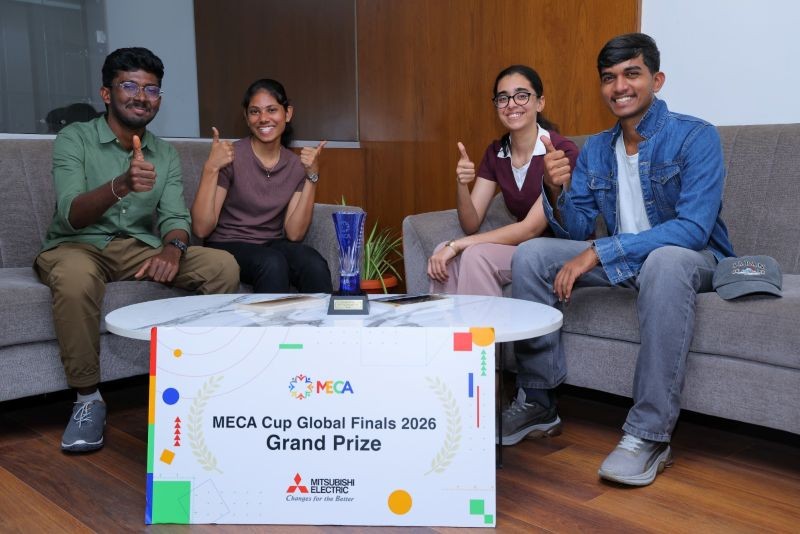
Salem/IBNS-CMEDIA: A team of engineering students from India has won the MECA Global Finals 2026, a factory automation contest organised by Mitsubishi Electric, held in Tokyo.
The Indian team emerged as the overall winner after competing against national winning teams from Japan, South Korea, Taiwan, Vietnam, the Philippines and Thailand, marking a significant achievement for young Indian engineering talent on the global stage.
The four-member team, Team Nexus AI from Sona College of Technology, Salem comprised final-year B.E. students Tharanika K, Seralathan R, Vijay B and Tharana A S. Led by Tharanika K, the team had earlier emerged as the winner of the 6th Mitsubishi Electric Cup National Level Competition held in Pune in February 2026.
The 1st and 2nd Runner-up titles were won by students of MKSSS’s Cummins College of Engineering for Women, and COEP Technological University, both from Pune, respectively.
The India leg of the competition received nearly 300 applications from engineering colleges. Following their national-level win, Team Nexus AI spent nearly 150 days developing and refining its solution with support from mentors and faculty members from Sona College of Technology’s Electrical and Electronics Engineering (EEE) Department, as well as Mitsubishi Electric India.
The team began developing the project in their third year in 2025, aiming to simplify industrial Programmable Logic Controller (PLC) programming using Artificial Intelligence.
At the global finals in Tokyo in early September 2026, the team presented an intelligent PLC programming assistant designed for Mitsubishi Electric’s automation systems. The solution allows engineers to describe a machine’s intended behaviour in simple English, which the AI then converts into industrial PLC code. The prototype was demonstrated before a global jury, with the team members explaining its technology, demonstrating its working and responding to detailed technical questions.
Sona College’s Team Nexus AI was declared the Gold Cup Winner at the global competition, receiving the winner’s trophy, medals for the team members and a cash prize of ₹1,00,000.
An excited Ms Tharanika K, leader of Team Nexus AI described the win as: “Winning the top global prize among all seven countries is a moment of immense pride for us. The win validates that innovations in our project stood out at a global level.
“We presented an intelligent PLC programming assistant for Mitsubishi Electric Automation at the rigorous competition, requiring teams to present their prototype, demonstrate its working and face judges’ questions”, she added. In addition to winning the grand award and the winner team trophy the team members received medals.

Sona Institutions’ Vice Chairman Chocko Valliappa present at the event to share the winning moments of the Sona students said: “Sona College team built a tool that lets an engineer describe a factory machine’s behaviour in simple English, and AI turns that description into working PLC code. The prototype won the approval of the jury and passed the rigours of jury questions.”
The solution is designed to address some of the challenges associated with conventional PLC programming, which can involve significant manual coding and testing and requires specialised technical expertise. This can increase development time and make errors costly to identify and rectify, particularly during machine commissioning.
With the team’s approach, an engineer can provide machine instructions in plain English. The AI converts these instructions into PLC code, which can then be reviewed, validated and tested on a digital twin before deployment on the physical machine. The approach is intended to accelerate development and validation while reducing programming errors, commissioning time and the effort involved in making changes on site.
The system also retains a human approval layer. AI provides programming suggestions and validation, while the final decision remains with the engineer. The system does not independently modify or deploy machine-control logic.
A member of the jury also highlighted the scalability of the solution, noting that while the demonstration was built around Mitsubishi Electric’s controller platform, its potential lies in its ability to be adapted across different machines and applications.
Dr. S. Sriram, COO & Director, Mitsubishi Electric India and BU Head – Factory Automation Systems, said, “Sona College of Technology’s achievement highlights what is possible when young engineering talent is given the opportunity to work on real industry challenges. From an industry perspective, simplifying and accelerating PLC programming can help make automation development faster, more flexible and reliable.
“What stood out in this project was the team’s focus on applying AI to a practical engineering problem while keeping the engineer firmly in control. This is the kind of industry-oriented innovation we want to encourage through the Mitsubishi Electric Cup, helping students understand not just technology, but how it can address real manufacturing challenges,” Dr Sriram added.
Atsushi Takase, Managing Director, Mitsubishi Electric India, said, “The success of Team Nexus AI is a proud moment and demonstrates the depth of engineering talent emerging from India and its potential to contribute to innovation on the global stage.
“At Mitsubishi Electric, we believe preparing future engineers requires opportunities to work with advanced technologies, engage with industry and test their ideas against global standards. We will continue to strengthen these connections and create platforms that enable young engineers in India to develop their capabilities and take their ideas to the world,” Takase added.
Allaying fears about any attendant risks in the model, a Sona team member R Seralathan told the audience that AI only validates and suggests, it doesn’t make final decisions. A human always stays ‘in the loop’ for approval, so AI isn’t given authority to autonomously change how the machine runs.
A jury member said that even though the demo used Mitsubishi’s controller platform, its real scalability strength lies in its portability across machines.
As part of the India leg of the competition, Team Nexus AI underwent multiple stages of technical evaluation supported by Mitsubishi Electric mentors and trainers. Following their national-level victory, the team continued to develop and test the prototype alongside their academic commitments.
The team acknowledged the guidance of their faculty mentor Dr. D. Prasad, the support of their student peer group and the encouragement of Sona’s EEE alumni and institutional leadership throughout the project.
Mitsubishi Electric India’s initiatives such as the Mitsubishi Electric Cup enable engagement with academic institutions and young innovators to develop practical automation solutions with real industrial and societal impact, while benefiting from industry mentorship in Factory Automation technologies.