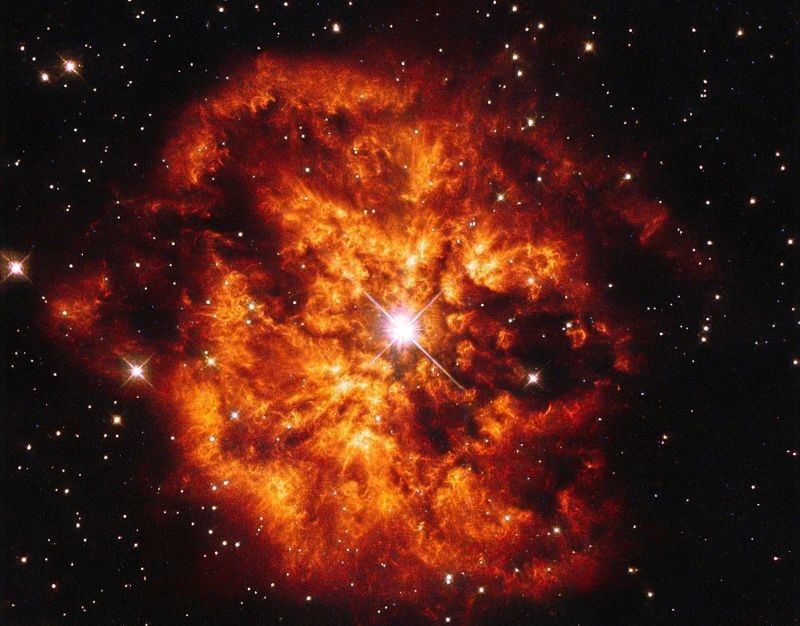
IBNS-CMEDIA: A breathtaking new image from the NASA/ESA Hubble Space Telescope reveals a rare cosmic pairing: the powerful star Hen 2-427, also known as WR 124, and the glowing nebula M1-67 that surrounds it.
Both objects are located in the Sagittarius constellation, roughly 15,000 light-years from Earth.
At the center of the image, Hen 2-427 shines intensely, while clumps of hot gas are being ejected into space at speeds exceeding 93,000 miles per hour (150,000 kilometers per hour). This dramatic expulsion of matter creates a striking spectacle in the surrounding nebula.
What kind of star is Hen 2-427?
Hen 2-427 is classified as a Wolf-Rayet star, a rare and massive type of star named after astronomers Charles Wolf and Georges Rayet.
Wolf-Rayet stars are known for being extremely hot and shedding enormous amounts of matter into space through strong stellar winds.
A young and vibrant nebula
The nebula M1-67, which envelops Hen 2-427, is estimated to be no older than about 10,000 years, a relatively short time in astronomical terms.
Despite its youth, it forms a spectacularly beautiful halo of gas and dust around the star, glowing brightly in the Hubble image, according to NASA.
This cosmic duo offers astronomers a vivid glimpse into the life cycle of massive stars and the dramatic processes that shape nebulae in our galaxy.