#Visva-Bharati University# Dr Probir Kumar Ghosh# Vice-Chancellor Visva-Bharati# university transformation# higher education India# academic reforms# institutional roadmap# Santiniketan# education leadership India
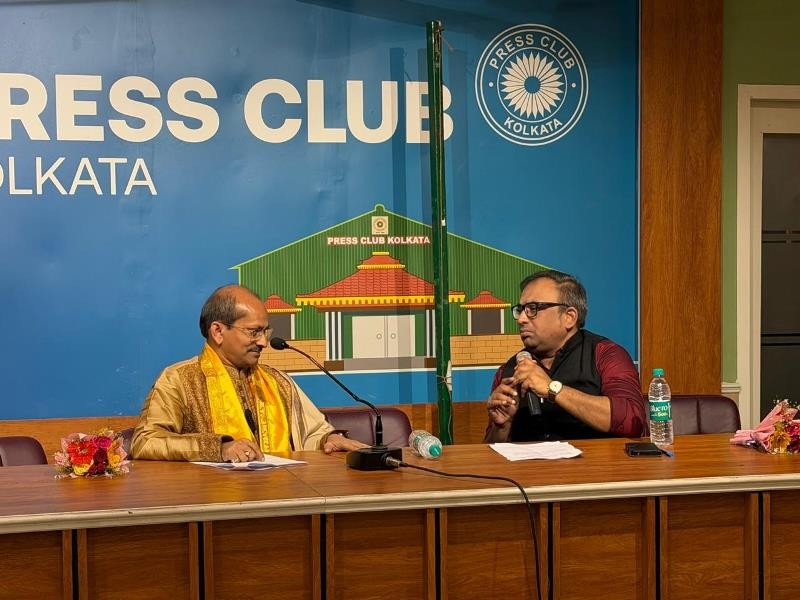
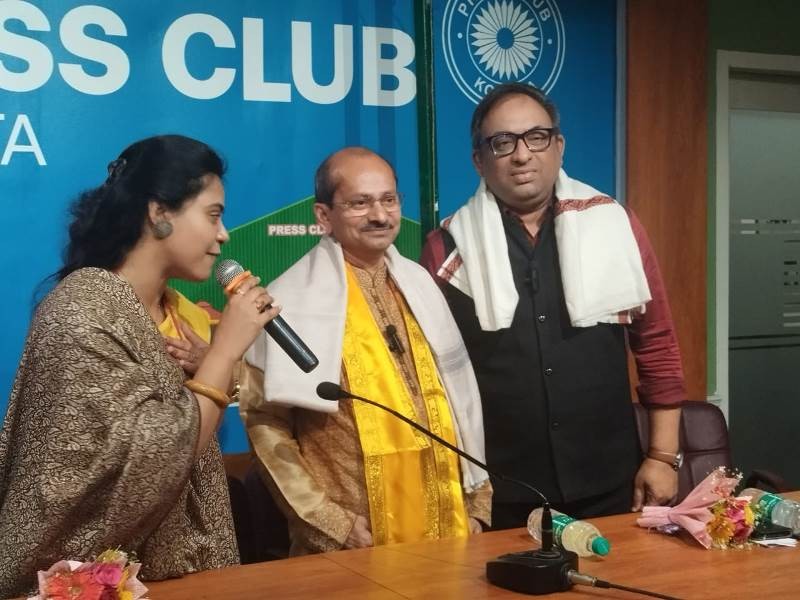
IBNS-CMEDIA: A felicitation and media outreach programme was held at the Calcutta Press Club, honouring Dr. Probir Kumar Ghosh, Vice-Chancellor of Visva-Bharati University, and noted public relations expert and social activist Subhojit Roy.
The event highlighted Visva-Bharati Unviersity’s renewed vision and decisive reforms under Dr. Ghosh’s leadership.
The program was organized Katha Bitan, a cultural forum.
Addressing the audience, Dr. Ghosh, who assumed charge approximately eight months ago after 35 years of leadership experience in the Ministry of Agriculture, outlined a comprehensive agenda spanning heritage conservation, academic reform, global outreach, sustainability, and student welfare.
Heritage & Cultural Revival: The university has prioritized conservation of its 48 heritage buildings, including Rabindranath Tagore’s residence. Acting on UNESCO recommendations, a Heritage Walk initiative was launched with a dedicated committee and 8 trained multilingual guides; the walks began on 3 August and will run four days a week from 1 January. Key initiatives include opening the Gurudev Archives, establishing the Nandalal Bose Gallery, and planning a Light & Sound Show at Uttarayan.
Global Outreach:Efforts are underway to revive ties with 38 countries associated with Gurudev, beginning with a 57-painting exhibition in Russia, academic dialogues with Argentina, Romania, and the USA, and partnerships with China and Japan. Foreign student admissions are being streamlined in line with Gurudev’s original vision.
Academic Reforms & Industry Integration: An Industry–Academia Meet saw participation from 81 industries, resulting in 5 MoUs, CSR collaborations, and corporate induction into the Placement Board. Curriculum modernization includes industry inputs, AI, and emerging technologies, alongside renewed coordination with the UGC.
Governance, Faculty & Student Welfare:Annual convocations will resume after a three-year gap. All 84 pending faculty promotion cases have been resolved, with corrective steps for non-teaching staff. Student welfare measures include improved food quality, filling vacancies, and recruitment for 73 posts at Path Bhawan and Shiksha Satra. Around 450 workers have been brought under Central Wage norms.
Green & Digital Initiatives:A long-term Green Campus plan includes waste management, bio-composting, reuse of water hyacinth by Shilpa Sadan students, and solar power coverage targeted within a year. Gurudev’s manuscripts are being digitized with the Asiatic Society, supported by the Ministry of Culture, Ministry of Education, and ASI.
Rural Reconstruction & NEP 2020: The revival of Gurudev’s rural vision includes adoption of 64 villages, expansion of a Yoga Village into journalism and sports education, and integrated farming. Visva-Bharati is positioning itself as a living model of the Indian Knowledge System under NEP 2020, engaging with 18 languages, and planning a Knowledge Conference (March 2026) and Alumni Meet (April 2026).
Innovation, Research & Future Vision: Plans include Poush Mela 2025 with ~1300 stalls and 100% digital transactions, university-funded faculty patents, seed funding for 10 student innovators, annual reviews of 456 faculty members, establishment of an AI Lab with IIT Kharagpur and partners, and initiatives on One Health & Climate Change. The revived studio facility is now among the best in India, with student exposure programmes set to begin next year.
Dr. Ghosh reaffirmed his vision to restore Visva-Bharati University to its original spirit and global stature within five years. In just 7–8 months, the university has recorded significant administrative, academic, cultural, and infrastructural progress, backed by a clear and ambitious roadmap for sustained transformation.
Subhojit Roy made his concluding remarks, acknowledging the efforts and lauding the vision of the V-C and hoped that Visva-Bharati University would champion a national cause such as Thalassaemia Eradication, reinforcing its social commitment.
Subhojit Roy has been spearheading a campaign, Thalassaemia Free India, creating awareness among the young population to test their blood for carrier detection.