
Researchers find that diversifying crops and integrating livestock improves farm efficiencies and ecosystem services in the US Midwest. The work is published in PNAS Nexus.
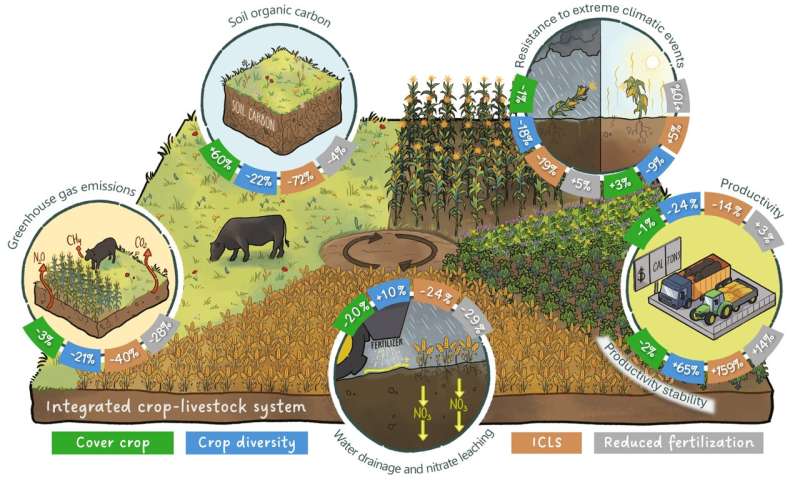
Mathieu Delandmeter, Bruno Basso, and colleagues used a validated crop simulation model to assess 18 management scenarios across 46 million hectares over three decades at high spatial resolution. The authors compared corn monoculture to diverse rotations with cover crops and integrated pasture-cattle systems, looking at each system’s productivity, profitability, yield stability, climate resistance, soil carbon, nitrogen leaching, and greenhouse gas emissions.
Increasing crop diversity from corn monoculture to corn-soybean-wheat rotation with cover crops increased productivity stability by up to 65%. Reducing nitrogen fertilizer by 25% decreased greenhouse gas emissions by 28%, converting systems from net carbon sources to net zero or sinks, while increasing economic returns by 3% due to lower input costs. Pasture-cattle integration systems showed 159% greater productivity stability and 5% higher resistance to extreme droughts compared to corn monoculture. Cover crops enhanced soil organic carbon sequestration by 55% on average.
The authors found plenty of trade-offs, with more diverse rotations having lower overall yields but greater economic stability and environmental benefits. According to the authors, their high-resolution approach across geographic scales helps identify management practices that optimize both economic and environmental outcomes to improve agricultural decision-making.
Provided by PNAS Nexus